Sunday, July 31, 2016

Students Discover a Galactic Eye of Horus

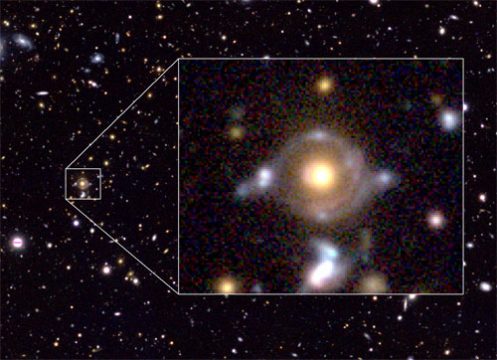
Eye of Horus in pseudo color. Enlarged image to the right. The yellow object at the center is a galaxy about 7 billion light-years away and bends the light from two background galaxies.
NAOJ
Undergraduate students in Japan stumbled on a rare lensing of two distinct background galaxies.

See article at SkyAndTelescope

Saturday, July 16, 2016

Farthest Known Object Orbiting the Sun

Observers calculate that Kuiper Belt object 2015 RR245 has an elliptical path that takes 733 years to go around the Sun and carries it from near Neptune's orbit out to 129 astronomical units.
Alex Parker / OSSOS team


First spied last year, an object designated 2015 RR245 turns out to be one of the largest and most distant objects yet found orbiting the Sun.

Complete story at Astronomy

Friday, July 8, 2016

NASA’s Juno Probe Successfully Reaches Jupiter

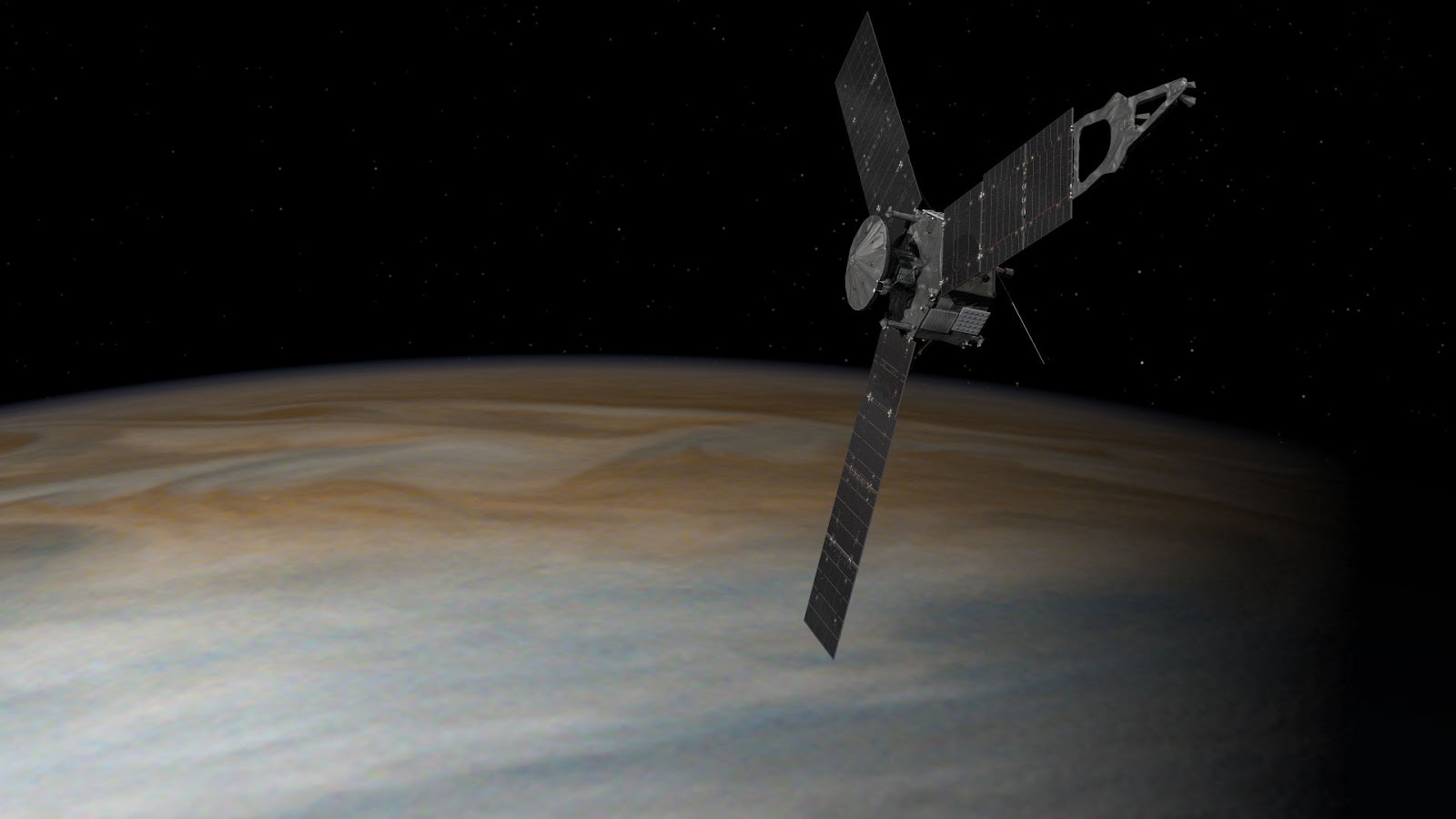
An artist's conception of Juno performing a 35-minute-long engine firing to enter orbit around Jupiter.
NASA / JPL
NASA's Jupiter probe, Juno, has completed a critical braking maneuver and has entered orbit around the gas giant.  Juno carried out a scheduled 35-minute-long burn that slowed its velocity by 542 meters per second (1,212 mph), enough to become a captured satellite of Jupiter with an initial 53.5-day orbital period. Arriving at 58 km per second (129,742 mph) with respect to the planet, Juno also performed the fastest orbital insertion to date.

Full details can be found at Astronomy.com

Monday, July 4, 2016

Thursday, June 30, 2016

A Middle Aged Sun?

(Photo credit YASSER AL-ZAYYAT/AFP/Getty Images)
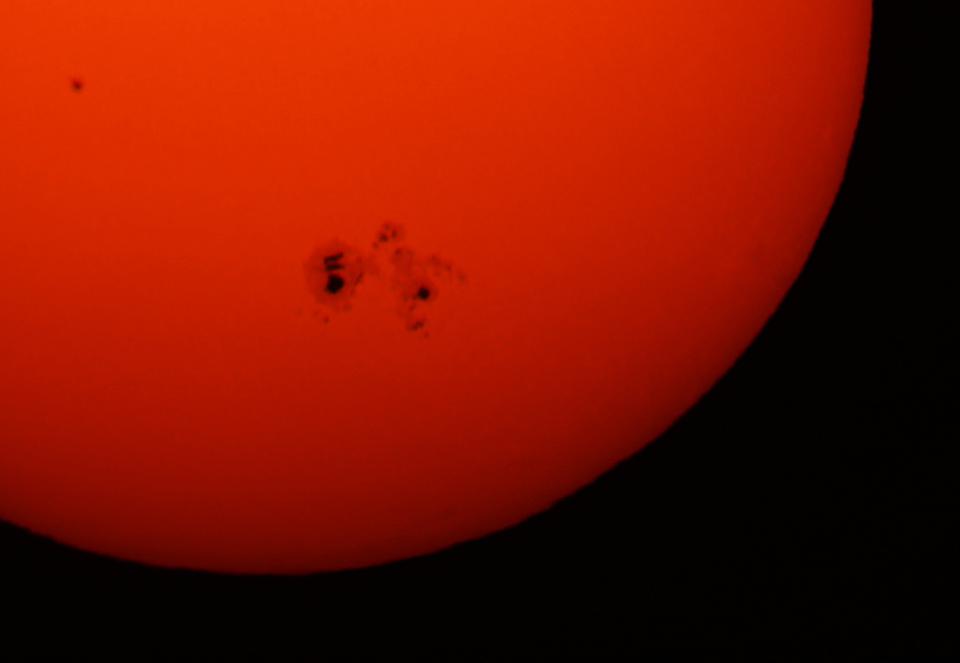
The Sun has likely already entered into a new unpredicted long-term phase of its evolution as a hydrogen-burning main sequence star — one characterized by magnetic sputtering indicative of a more quiescent middle-age. What this means for us astro-photographers is that there may be fewer and fewer sunspots and flares.  But I don't think we need to worry yet ...

See Forbes for the complete story.

Monday, June 27, 2016

Time Travel Not Likely - Pear Shaped Nucleus Says So! Maybe!

Physicists have confirmed the existence of a new form of atomic nuclei, and the fact that it’s not symmetrical challenges the fundamental theories of physics that explain our Universe.  For one, it means that time travel into the past is not possible.  However, the good news is that the discovery could help scientists solve one of the biggest mysteries in theoretical physics - where is all the dark matter?

Read the full story at Science Alert.

Friday, June 24, 2016

An ocean for Pluto and a thinner ice shell on Enceladus

NASA/JHU-APL/SwRI

Once, we thought Earth was the only planet with oceans. But now, we’re seemingly finding them everywhere in our solar system.

Complete story on Astronomy.com

Monday, June 20, 2016

Astronomy Photos on Flickr


Don't know why I didn't do this earlier ... to make it easier for everyone to view my Astronomy photos I've created a number of albums on Flickr so you can see them all without having to load each one separately on AstrobinAstrobin is the preferred site if you want detailed information about the images, but if you're just interested in viewing the loveliness, then Flickr is best.

Not all my photos have been uploaded yet.  The Messier Objects are the first set.  I'll be uploading the NGC (Nebulae, Galaxies), Comets and Planets in the coming days.

Photos on Flickr

Thursday, June 16, 2016

A Surprise While Observing Gravity Waves - Dark Matter?

Physicists suggest we might have just found dark matter while detecting gravitational waves. 

For the complete story visit Science Alert

Monday, June 13, 2016

Caught SN2016coj!

Moon or not, the skies cleared nicely on Sunday evening and so I set up to image SN2016coj.  Being able to image a supernova in a year is a privilege, two in the same month is almost unheard of!
I've not imaged NGC4125 (a 10th-magnitude elliptical galaxy in Draco) before so I have nothing to compare against, but the word on the internet is that the supernova is very obvious.  Alas, as can be seen in the image, the supernova itself is almost brighter than the nucleus of the galaxy itself.  Here is the image I captured.


The forecast for the next week is not looking good, and the moon will be waxing large.  But if SN2016coj continues to brighten it may really make for a good image in the next couple of weeks.  If it starts to dim, so be it - I'll be able to compare it against earlier images.  

Friday, June 10, 2016

Another Supernova this month!

No sooner did I get a chance to image a supernova this year that I heard about another one. This time in NGC 4125, a 10th-magnitude elliptical galaxy in Draco. There are a fair amount of supernovae discovered in a single year, but I'm talking about ones bright enough to be imaged, or even visually observed (with a telescope of course).

With the cloudy skies returning, and then the moon getting in the way, it may be a challenge to image SN2016coj this month, but I will try.  Details on both of the supernovae can be found at
Sky and Telescope.

Day 16 - Night Sky Observatory

Today marks a milestone in the Night Sky Observatory build - the completed observatory (in manual mode)! In the next few days I will be star...