I am still processing all the images I took, but here is the moon at mid-eclipse which occurred at 4:02AM.
 |
| Mid-eclipse - November 19, 2021, 4:02AM GT102 (562mm; f/5.5) - Canon 50D; ISO 200; 4 sec |
|
| Mid-eclipse - November 19, 2021, 4:02AM GT102 (562mm; f/5.5) - Canon 50D; ISO 200; 4 sec |
The first eleven days of September offered me some excellent seeing conditions for a change and so I was very busy taking lots of subs for a number of new and interesting deep space objects.
First up is Sh2-132 which is a relatively faint emission nebula about 10,000 lightyears distant in the constellation of Cepheus the King. Commonly known as the 'Lion Nebula' due to its shape (you can make out the head at the upper left, tail to the right, with four legs below). It features a conspicuous dark lane in the "head" section.
This image was taken over five nights, with a total integration time of about 16 hours; 14 of those hours in narrowband and the remaining in RGB to capture the stars.
 |
| Sh2-132 - Lion Nebula in SHORGB William Optics GT102 (f/5.5) with ZWO ASI2600mm Camera September 3, 6-9 2021 |
 |
| LDN 688 & 694 in LRGB William Optics GT102 (f/5.5) with ZWO ASI2600mm Camera September 9 and 10, 2021 |
Finally, we have LDN 900 which is a Dark Nebula in the constellation of Cygnus. It is approximately 8 arc-minutes (0.133 degrees) in size.
 |
| LDN 900 in HaLRGB William Optics GT102 (f/5.5) with ZWO ASI2600mm Camera September 10 and 11, 2021 |
Dark nebulae are interstellar clouds that contain a very high concentration of dust. This allows them to scatter and absorb all incident optical light, making them completely opaque at visible wavelengths. The nebula (centered in the image and running top to bottom) obscures the background of dust and ionized gas.
The blue regions are vdB 131 (upper) and vdB 132 (lower). These are both reflection nebulae, regions of what have been dark nebulae if not for the fact that the dust reflects the light from nearby bright stars that is not hot enough to ionize the cloud's hydrogen. This scattered light generally appears blue since the typical size of dust grains in the cloud are comparable to the wavelength of blue light.
This image is 5 hours of Hydrogen-alpha (Ha) and 4 hours of LRGB.
It's not often that I blog about amateur high power rocketry in this space since I essentially have just about ended (but not entirely!) my efforts in that hobby as of late. Between the time (and expense) of running my telescope(s) and doing all other manner of hobby and hobby-like activities rocketry has taken back stage. It was getting really difficult to lug around all the equipment to the rocket field on the eastern shore of Maryland, not knowing if the weather conditions were going to be suitable for launch until the last minute. And add to that, taking the better part of an entire day prepping my large rocket(s) and then having to chase them down when they drift to the edge of the launch site and carry them back to the launch area. Some of my largest rockets weigh in at 50-150 lbs. plus. Gets to be problematic in the summer heat, and almost equally so in the winter chill at my age. I still plan to continue in the hobby, but only building and flying small to mid-size rockets.
However, in the most recent Sport Rocketry magazine is a feature article on Project Final Cut, an amazing rocket built and flown by Doug Gerrard of Socorro, New Mexico. This incredible project is an 8" diameter rocket with a 98mm central motor mount and six 54mm strap-on boosters. It is over 15ft tall and weighs in at just under 190lbs at liftoff. Doug's passion is launching rockets and capturing photographic footage and stills. For the last 33 years nearly all his rockets carried camera payloads and all of them were named after photography/movie terms. This project, likely his last, is appropriately named "Final Cut". On board there are 13 cameras, 12 altimeters/timers and 7 motors. The central motor is a 15-second burn N1000 and the outboards are six K270 long burn motors. All seven were planned to ignite at once to lift the massive rocket into the sky. Then at about T+7.5 seconds, the strap on boosters would separate in pairs while the main motor continues it's burn. Although the flight had a few issues, the rocket reached an altitude of 11,000 ft. and landed successfully not far from the flight line.
 |
| Final Cut launch |
With cameras in the main rocket, in the strap-on boosters and on the launch tower, the footage captured was incredible. Looking to the rear of the main body tube was a special high-speed Chronos 1.4 camera with a 1" sensor that records at 1080P at 1000 frames per second. Video of the launch can be found on Vimeo (https://vimeo.com/558878230) - a must see!! One thing to keep in mind while watching the video is that all the clips are played back in slow motion. This makes the rocket appear to take a long time to take off and the sound of the motors is a thundering roar. In real time amateur rockets accelerate rather quickly; usually in excess of 5gs, the lowest recommended acceleration for safe launch since these rockets are fin stabilized and need to move at 30 -45 ft per second to achieve flight stability. Because all of the motors used in Final Cut were long burn motors, the rocket only accelerated at a max acceleration of 4.5gs, and therefore the team constructed a special launch rail that was twice the normal 12ft length to keep the 'pointy-end' pointing up until the rocket reaches the required minimum velocity for fin stabilization.
It's projects like Final Cut that make me want to get out there and get another one of my birds in the air. Maybe even design a similar rocket. We'll see :)
Final Cut launched at NAR's National Sport Launch (NSL 2021) in Alamosa, CO, during the last weekend of May. Additional details can be found at: NSL 2021 and NSL 2021 - Facebook, as well as in the Sept/Oct 2021 issue of Sport Rocketry.
Oh my gosh, what a terrible summer season for astrophotography. There was maybe 5 relatively clear nights since July 12 when I completed the tandem telescope setup. I had expected to image my favorites by now - the Trifid, the Lagoon, etc., with my new ASI2600 camera, but alas, that's probably not going to happen now as they are slowly receding in the southwest. I may have another couple of weeks to give them a try while the moon is out of the picture, but if the weather doesn't cooperate soon I may need to wait until next year.
However, I did point my scope to an object I have never imaged before. It is well placed in the sky, high and to the SE allowing me to run long series of narrowband images throughout the entire evening. This object is WR134, a Wolf-Rayet star with surrounding nebulosity. A tough one for sure, but I wanted to give it a try. The star itself is nondescript, but because of the intense radiation it spews forth, the surrounding gas, excited by the star's radiation, glows brightly.
Wolf–Rayet stars, often abbreviated as WR stars, are a rare heterogeneous set of stars with unusual spectra showing prominent broad emission lines of ionized helium and highly ionized nitrogen or carbon. The spectra indicate very high surface enhancement of heavy elements, depletion of hydrogen, and strong stellar winds. The surface temperatures of known Wolf-Rayet stars range from 20,000 K to around 210,000 K, hotter than almost all other kinds of stars. (Wiki)
WR 134 is a variable Wolf-Rayet star located around 6,000 light years away from Earth in the constellation of Cygnus, surrounded by a faint bubble nebula blown by the intense radiation and fast wind from the star. It is five times the radius of the sun, but due to a temperature over 63,000 K it is 400,000 times as luminous as the Sun. (Wiki)
Over the nights of August 2, 3 and 6, I captured both Ha and Oiii narrowband data, 65 subs of 300 sec exposures for each, and a series of RGB subs to get the star colors correct. I had planned to get Sii data as well (to complete the standard SHO Hubble Palette) but the clouds moved in and stayed for awhile! So, with what I had, I processed a HOO palette, the results shown in the image below.
 |
| WR134 and Nebulosity (August 2021) WO GT102 f/5.6 - ASI2600mm Pro 65x300s Ha; 65x300s Oiii; 10x30s RGB Stars |
WR134 is the brighter star in the small group of four stars at the center of the image. The enlarged central region clearly shows the star (reddish-white at center) with the bubble nebula surrounding it. The upper region of the bubble, bluish in color, is the Oiii ionized gas.

 |
| WR134 and Nebulosity (August 2021) WO GT102 f/5.6 - ASI2600mm Pro 65x300s Ha; 65x300s Oiii; 67x300s Sii; 10x30s RGB Stars |
So, I have at least one new image to add to my collection from the 2021 summer season. Hopefully I'll capture some other deep space summer gems before they move out of view until next year.
On the night of August 15, 2021, a very rare alignment of Jupiter's moons occurred. On this night a triple transit on Jupiter with the moons Callisto, Ganymede and Europa in transit was visible from some parts of the world. After the triple transit there was very rare event when Ganymede occulted Europa followed by Ganymede eclipsing Europa!
Although I have tried my best to capture images of the planets the seeing at my location in Maryland is usually awful - and good seeing is an absolute 'must have' in planetary imaging. This event would have been one that I would have certainly tried for, but the weather conditions (clouds, go figure) nixed that.
However, Christopher Go, one of the handful of the best amateur planetary photographers, had excellent conditions at his location in the Philippines. He was able to capture the entire series of events with his 14" Celestron SCT.
Here is the NASA Astrophoto of the Day that he was awarded.

For a more complete review of Christopher's imaging, including this event, point your browser to his web page at http://astro.christone.net
Last week, NASA’s Perseverance rover shot for a new milestone in the search for extraterrestrial life: drilling into Mars to extract a plug of rock, which will eventually get fired back to Earth for scientists to study. Data sent to NASA scientists early on August 6 indicated a victory—the robot had indeed drilled into the red planet, and a photo even showed a dust pile around the borehole.
 |
| NASA |
While this is not the 'hole in one' we hoped for, there is always risk with breaking new ground," Thomas Zurbuchen, associate administrator of NASA's Science Mission Directorate in Washington, said in a statement. (Perseverance's mission is the first step in a Mars sample-return campaign, which has never been done before.)
Read the full story at ARS Technica
Perseid meteors scream through our atmosphere at nearly 40 miles per second, so they often leave behind long, glowing, persistent trains. The shower gets its name from the point in the sky where the meteors appear to originate - the radiant. When the radiant is high in the sky you can capture the most meteors. As typical of most meteor showers, this occurs in the early morning hours - and this year that would be on Thursday, August 12 around 2 A.M when up to 100 meteors per hour can be seen (in dark suburban skies). Since this particular shower is so plentiful, it's possible to spot the meteors as early as 9 p.m.
Although that is the best time to view them, don't worry if you miss the peak as this shower typically builds up and winds down slowly, so you can head out on any of the few days before and after the 12th as well.
 |
| JASON WEINGART / BARCROFT MEDIA |
In order to achieve the best views avoid artificial light as much as possible when viewing the shower. This doesn’t necessarily mean you need to travel to a dark-sky site. Just try to keep nearby street and house lights out of your line of sight.
Pick a comfortable location where the view to the north-east is unobstructed. Lie back so that a large swath of the sky is visible and you are not straining to keep you head looking up. A lounge chair or recliner works well. Look for Perseid meteors at an altitude around 60˚ in any direction. If you want to see the most faint meteors be prepared to spend about 20-30 minutes to allow your eyes to get dark-adapted.
Meteors are fragments of periodic comets, the dust and debris that they leave behind in their orbits. In the case of the Perseids, that comet would be Swift-Tuttle, which orbits between the Sun and beyond the orbit of Pluto once every 133 years. Every year, the Earth passes near the path of the comet, and the debris left behind by Swift-Tuttle shows up as meteors in our sky as they burn up in our atmosphere.
Yesterday my wife and I needed to drop off our aging poodle Lucy for dental surgery at the Center for Veterinary Dentistry and Oral Surgery in Gaithersburg. The surgery was to take about 3-4 hours, and so after we arrived at around 7:45AM, we had some time to kill. Our ultimate location was Capital Quilts (directly across the parking lot from the Veterinary Center), but it didn't open until 11:00.
So we headed over to the Silver Diner RIO in the new RIO Lakefront Mall where we had a wonderful breakfast/lunch. We then took in the sights of the small lake/pond, this after I spent 15-20 minutes searching for my car in the parking garage. Turns out I entered from a different side and got disoriented. This is what happens when you reach the senior years!
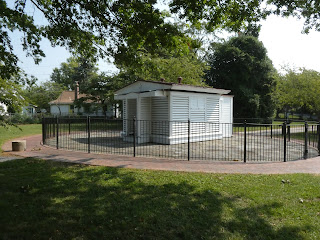
But just prior to getting to the quilt shop, we headed to a small park that Joan had researched as a possible site to visit - an interesting astronomy related site called the International Latitude Observatory. Nestled right in the middle of a small area called Observatory Heights lies the Observatory Park, just across from Gaithersburg High School. A small park, with only about eight parking spaces on the small street, surrounds the International Latitude Observatory.
Built in 1899 the Gaithersburg Latitude Observatory became part of an international project to measure the earth’s wobble on its polar axis. The Observatory operated from 1899 to 1982, when satellites replaced human observers. It is still active, however, with GPS systems using survey markers installed on these grounds to make periodic course corrections. Fully restored in the 1980s, the observatory building, the meridian mark pier, and the five geodetic monuments scattered throughout the park are listed on the National Register of Historic Places.
Unfortunately (or maybe not) the observatory building was gated off and locked, but it was a nice place to visit.
 |
| View along the Meridian line |
 |
| Meridian Mark Pier used to align the telescope |
 |
| Markers representing one of the other four locations |
NASA's Hubble Space Telescope is back in business, exploring the universe near and far. The science instruments have returned to full operation, following recovery from a computer anomaly that suspended the telescope's observations for more than a month.

New images have been downloaded showing some interesting odd galaxies.
See Phys Org for more details on the fix and the new images.
With the summer nebulae making their return I need to switch to my wide field refractor to capture these colorful deep space objects. Problem is, removing the 11" Edge from the mount requires a bit of effort and then the mounting plates need to be readjusted. Once the plates are done and the GT102 mounted I need to rebalance the scope. If I then decide I need to photograph planets this summer, or even some small planetary nebulae, the whole process repeats, as I remove the GT102 and add the Edge.
Ever since I got the new AP1100 mount I've been toying around the idea of mounting both OTAs in tandem. The mount can handle up to 110 pounds and I figured the two scopes would come in around 60 pounds including the camera and guide scope. That way I could just cover the two scopes when not being used and leave them on the mount. I could then image from either one just by moving the camera from one OTA to the other. A little bit of rebalancing may be needed, but that shouldn't be too hard.
So this past week I ordered a new 18lb counterweight. It arrived last Friday. I then mounted a dovetail plate on top of the Edge, and with two ADM clamps on the WO GT102 it was mounted on top of the Edge. The 50mm guide scope sits atop the GT102. With all the camera equipment attached I needed the new 18lb counterweight as well as my 5lb one to get the whole system balanced. Now all I need is some clear nights to check everything out.

The only other issue that needs addressing is the cover. The existing Telegizmo 365 cover could work, but it would be a tight fit and would not reach to the bottom of the pier. I contacted Telegizmo to see about ordering a custom fitted cover. I await their response. Based on my measurements a new cover would allow me to keep ALL the equipment (Power supplies, computer, dew controllers, power distribution panel, etc.) out covered and protected.
So it goes. Hopefully, new summer nebulae images will soon be on the way.
Back in July and August of 2020 I imaged M16, the Eagle nebula, which contains, at it's center, what has become one of the Hubble telescopes famous images - the Pillars of Creation. I used my EdgeHD11 telescope to close in on the central portion of the nebula where the pillars reside.
The processing of the image took much effort, and every time I completed the final image I was not pleased with the results.
Last week I tried a new technique for processing these images and together with some new software I was finally able to get a good result. So here is my version of the Pillars of Creation, in narrowband, Hubble palette.
 |
| M16 - Pillars of Creation - July/August 2020 EdgeHD-11 at f/11 with ASI1600mm pro 13 hours Ha, O3, S2 Narrowband w/RGB stars added |
Complete details can be found at Astrobin
Day 14, August 29th, the dome assembly was completed - stainless steel track plates were screwed to the bottom flange of the dome to provide...