Friday, April 6, 2018

Man made protection around Earth ... Interesting.

NASA
In 2017, NASA space probes detected a massive, human-made 'barrier' surrounding Earth.
And tests have confirmed that it's actually having an effect on space weather far beyond our planet's atmosphere.
That means we're not just changing Earth so severely, scientists are calling for a whole new geological epoch to be named after us - our activities have been changing space too.
But the good news is that unlike our influence on the planet itself, that humongous bubble we created out in space is actually working in our favour.
Check out the complete story at Science Alert

Wednesday, March 21, 2018

Presentation Cancelled

Due to the weather situation, the presentation on High Powered Amatuer Rockets is cancelled for this evening.  We will reschedule and send out a new announcement at a later date.

Thursday, March 8, 2018

Amateur Rocketry Presentation

I will be guest speaker at the Chesapeake Chapter of INCOSE on Mar 21, 2018 (6:00 - 8:00) presenting "The Engineering of High Power Amateur Rockets". This is the same presentation I gave back in 2015 (with a few modifications). With only 1hr for the talk this is just a brief introduction to my hobby in rocketry but covers most everything involved. It will be at APL in Laurel, MD.

There is a cost for the dinner, but attending the presentation is free. Details at:

Sunday, February 18, 2018

Supernova in Galaxy NGC 3941

On early Saturday morning I was experimenting with my new camera and decided to image a new supernova in galaxy NGC 3941.  This type Ia supernova was discovered on 2/3/2018 by Masaki Tsuboi and is located 4".1 east and 0".8 north of the center of NGC 3941.  At the time of discovery it was Mag 13.0; I estimated mag 14 when I captured it.

SN 2018pv in NGC 3941
EdgeHD11 f/7 - ASI1600mm Luminance only (40x10sec)
February 17, 2018

To give you an idea of how bright supernovae get, consider that NGC 3941 is a barred lenticular galaxy located in the constellation Ursa Major at a distance of 40 million light years from Earth. The supernova is almost outshining the center halo of the galaxy - one star - almost brighter than the whole collection of millions of stars in the galaxy!  If a star in our own galaxy were to go supernova it would outshine all other objects in the sky except the sun and would be visible in broad daylight. This actually happened back in 1054 AD.

The Crab Nebula (catalogue designations M1, NGC 1952, Taurus A) is a supernova remnant in the constellation of Taurus. The now-current name is due to William Parsons, 3rd Earl of Rosse, who observed the object in 1840 using a 36-inch telescope and produced a drawing that looked somewhat like a crab. Corresponding to a bright supernova recorded by Chinese astronomers in 1054, the nebula was observed later by English astronomer John Bevis in 1731. The nebula was the first astronomical object identified with a historical supernova explosion (wikipedia).

Wednesday, February 7, 2018

Tuesday, February 6, 2018

Falcon Heavy Success!!!

Falcon Heavy Launch - Feb 6, 2018


Congrats to SpaceX for a fantastic test flight of the Falcon Heavy rocket.  What an unbelievable launch. A dream that has eluded NASA was achieved yet again by SpaceX - the launch and landing of reusable rocket boosters. This time, two of them, side by side, simultaneously!

And the stage-2 rocket is sending one of Elon Musk's Tesla Roadsters on a course toward Mars. Yep, you read that right - Mars. He revealed surreal live video feeds of the car cruising around the planet, complete with a “Don’t Panic” dashboard message, a dummy astronaut in the driver’s seat, and David Bowie on the radio.

The only down-side to a picture perfect launch was the unsuccessful landing of the middle core of SpaceX’s huge rocket which missed the drone ship where it was supposed to land. The center core was only able to relight one of the three engines necessary to land, and so it hit the water at 300 miles per hour. Two engines on the drone ship were taken out when it crashed, SpaceX CEO Elon Musk said in a press call after the rocket launch (as reported by The Verge).

Visit YouTube for the video coverage of the launch.

Sunday, February 4, 2018

New Astrocamera on the bench in test

ZWO ASI1600mm Pro Camera with
EFW 8-position Filter Wheel


It's been about 2 years since I purchased my QHY10 OSC (One Shot Color) camera and I've taken a number of nice astrophotos with it, both at the prime focus of my EdgeHD as well as on the Hyperstar wide field lens. But the "real-deal" in astrophotography is though the use of mono (black and white) cameras. In the OSC case, the image is taken in color, much like a normal digital camera. In this scenario, the light must pass a filter in the camera known as a Bayer Matrix, which consists of alternating red, green (2x as many as red and blue) and blue filter elements. A given sensor therefore contains 25% red sensitive pixels, 50% green pixels and 25% blue. So the light from a object in space is split into these groupings. What this means is that a predominately red object is only captured by 25% of the pixels on the sensor (and lots of deep space objects tend to be in the red end of the spectrum). Much of the sensor is wasted and the sensitivity is greatly reduced.

A mono camera captures all the light all the time. That means it is much more sensitive and captures a lot more data in any given exposure. But if its mono, how do you get a color photo?

Astrophotographers use a set of colored filters to achieve a final image. Four separate exposures are necessary to create a single color photo - one through a red filter, one through a green, one through a blue and finally one through a clear, or luminance, filter. These are then combined later in software post processing to produce a color image. So the time on the telescope is quadrupled when imaging with a mono camera, but the results are of greater quality and capture much more detail in the dim regions of an object.

So I've been spending some time testing and getting the software set up to handle the new camera while the skies are cloudy. The photo shows the ASI1600mm Pro being tested with it's filter wheel attached. Much to do as I hope to test it out on real space objects in the coming days.

Saturday, February 3, 2018

Follow the bouncing "Universe"!

 
An interesting theory now proposes that the universe didn't come from a colossal explosion (the Big Bang) but rather as the result of a cosmic bounce - a collapsing universe reaches a point where it bounces back and starts expanding again.

The theory is rather interesting, and doesn't need the controversial 'inflation' part of the popular Big Bang theory.

Read more at:  Quanta Magazine

Wednesday, January 17, 2018

Fundamental physics is frustrating physicists


No GUTs, no glory ...

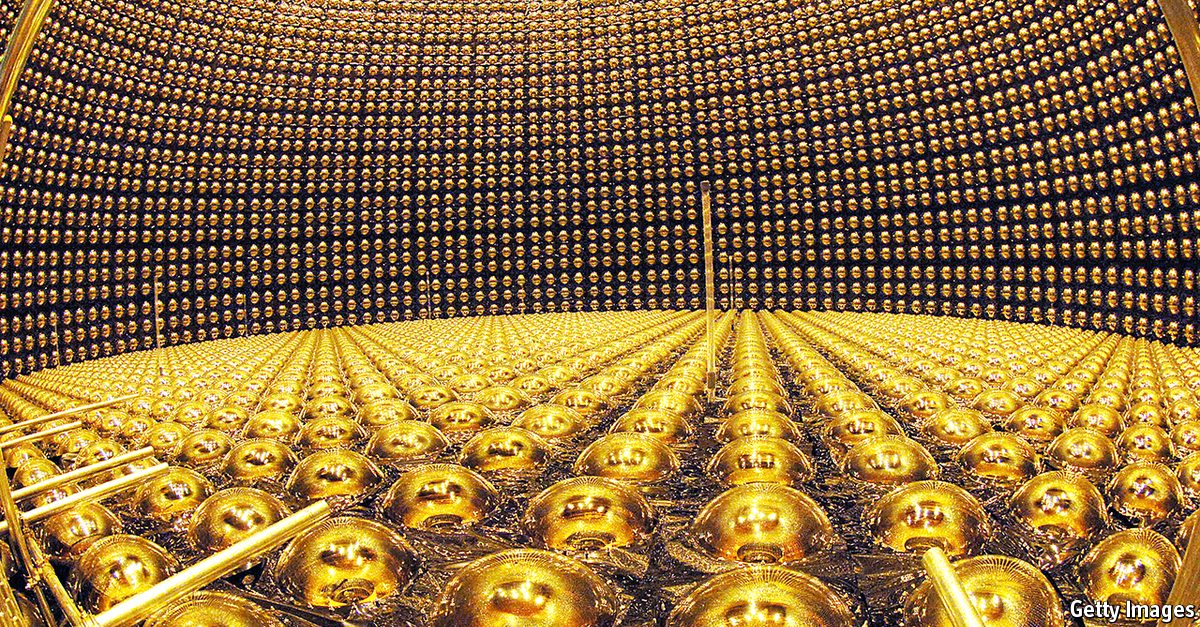
DEEP in a disused zinc mine in Japan, 50,000 tonnes of purified water held in a vast cylindrical stainless-steel tank are quietly killing theories long cherished by physicists. Since 1996, the photomultiplier-tube detectors (pictured above) at Super-Kamiokande, an experiment under way a kilometre beneath Mount Ikeno, near Hida, have been looking for signs that one of the decillion (1033) or so protons and neutrons within it (of which a water molecule contains ten and eight respectively) has decayed into lighter subatomic particles.
That those tubes have, in the more than 20 years the experiment has been running, failed to do so is a conundrum for physics, and one that is becoming more urgent with every passing month.

For the complete story head on over to The Economist

Wednesday, December 13, 2017

Geminids Meteor Shower Tonight

If you had to pick one night for watching the 2017 Geminid meteor shower, it’d probably be December 13 (morning of December 14). The nights before and after should be good as well. On a dark, moonless night, the Geminids are known to produce 50-120 meteors per hour, or nearly 1-2 meteors per minute. This year, with the Geminids’ parent object – 3200 Phaethon – nearby, you might see more. Plus, the moon is in a waning crescent phase for this year’s shower; it won’t interfere, and it’ll be passing some predawn planets.

Check out EarthSky for the top 10 tips for watching this shower. 

Friday, December 8, 2017

NGC 7000 - The North America Nebula

During the later part of November when we had some nice run of clear, moonless nights, I imaged a lot of DSOs (Deep Space Objects).  Finally got around to processing NGC 7000.

The North America Nebula (NGC 7000 or Caldwell 20) is an emission nebula in the constellation Cygnus, close to Deneb (the tail of the swan and its brightest star). The remarkable shape of the nebula resembles that of the continent of North America, complete with a prominent Gulf of Mexico. It is sometimes incorrectly called the "North American Nebula". The North America Nebula is large, covering an area of more than four times the size of the full moon; but its surface brightness is low, so normally it cannot be seen with the unaided eye. Binoculars and telescopes with large fields of view (approximately 3°) will show it as a foggy patch of light under sufficiently dark skies. However, using a UHC filter, which filters out some unwanted wavelengths of light, it can be seen without magnification under dark skies. Its prominent shape and especially its reddish color (from the hydrogen Hα emission line) show up only in photographs of the area. The portion of the nebula resembling Mexico and Central America is known as the Cygnus Wall. This region exhibits the most concentrated star formation. (Wikipedia)

NGC 7000  -  November 20, 2017
EdgeHD11 w/Hyperstar and QHY10 Camera
30x180sec subs at f/2


I had imaged this object with my William Optics 102mm APO, but the EdgeHD11 with Hyperstar lens really pulls out the detail.  There is however, some issues with my setup of the Hyperstar.  If you look closely at the top left of the image the stars are actually small donuts; at the bottom right they are pinched. I'm pretty sure this is an issue with the camera not aligning properly to the Hyperstar lens; something which I have struggled with in the past to correct.

Day 16 - Night Sky Observatory

Today marks a milestone in the Night Sky Observatory build - the completed observatory (in manual mode)! In the next few days I will be star...