The new pier pads have been completed and the telescope mount re-assembled. I was able to spend a few hours recalibrating and realigning the scope this past Monday. First new photos will be attempted this weekend.


The new pier pads have been completed and the telescope mount re-assembled. I was able to spend a few hours recalibrating and realigning the scope this past Monday. First new photos will be attempted this weekend.
As reported in my previous blog, I have been having problems with moles digging in under my telescope pier. I finally found the time to make the repairs.
I decided to do the construction in the same location as the original mount to keep from having to redo the Lat/Lon data used in all my software. Each footing was dug in about a foot into the ground at each tripod leg location.

Once the holes were dug, I removed the layer of grass completely around the pads.

Then, paver base was poured into each hole and tamped down. I ended up using sufficient base to go to a depth of 10"-12"; a bit overkill, but I had the material.

Next, paver sand was placed at a depth of 1".
The plan was to use 12"x12"x1.5" paver stone to support the tripod pier. I needed three at the southern point and two at the other locations to handle the ground grade. I was concerned that the stones would slide on each other, so I cemented them together with stone mortar. Paver sand was tamped in around each set of stones.

Finally, ground cover to prevent grass and weeds from growing and ornamental marble gravel was spread around the entire area.

The pier was placed on the pads and adjusted to line up true north. The first section of the telescope mount was attached and alignment was double-checked. I needed to move the legs slightly, so they are not perfectly centered on the stone pads, but this is not a problem.
Next, the wiring needs to be installed and the second section of the mount connected. But that is for another day.

 |
| M82 (Cigar Galaxy) - May 10, June 4,5,6, 2022 EdgeHD11; ASI2600mm at f/10 4 hours Ha; 4 hrs RGB color https://astrob.in/mhkrsd/0/ |
Well the potential meteor storm didn't pan out - not that I was surprised. But I did have the telescope out imaging that night so I was able to capture the Needle Galaxy with my new ASI533MC camera.
 |
| Needle Galaxy (NGC 4565) May 29-30, 2022 EdgeHD 11; ASI533MC (73x180sec subs) |
NGC 4565 (also known as the Needle Galaxy or Caldwell 38) is an edge-on spiral galaxy about 30 to 50 million light-years away in the constellation Coma Berenices. It lies close to the North Galactic Pole and has a visual magnitude of approximately 10. It is known as the Needle Galaxy for its narrow profile. First recorded in 1785 by William Herschel, it is a prominent example of an edge-on spiral galaxy. (wiki)
This image run was to be another test of my ASI533MC camera, and the results have really panned out to be above my expectations. This camera, unlike my ASI2600 and ASI1600, is a OSC (one shot color) sensor (similar to a standard digital camera). This makes capturing and processing the astro-images much easier and less time consuming at the expense of not being able to image through NB filters, or take advantage of the higher sensitivity of the monochrome sensors in the 1600 and 2600. It also sports a square image sensor, which takes a bit getting used to.
The ASI533MC was actually purchased for a number of reasons. First of all, for cometary imaging you don't have to deal with the three RGB filters and can spend the time capturing lots of single color subs. And since comets move noticeably in their orbits while being imaged, dealing with single color subs makes it a whole lot easier to process the final image. Second, it is planned to be added to my new wide field portable telescope for ease of transporting and operation in the field. And finally, it can used in the Hyperstar setup on my EdgeHD 11 for super fast, f/2 imaging with an 11" aperture telescope.
Hopefully in the coming months I'll be able to try out all three of these uses to see how well the ASI533MC performs.
 |
| S&T Diagram / Gregg Dinderman |
Late Sunday evening, May 15, 2022, the Moon will slip into the earth's shadow for one of the best total lunar eclipses in a long time. Conditions are favorable for a dark, ruddy red moon, as the path takes our satellite deep within the umbra of the earth's shadow.
Details below are from Sky and Telescope
On Sunday night–Monday morning May 15–16, the Moon will undergo a total eclipse widely visible across the Americas, Europe, and Africa as seen in the diagram below:

As the moon moves through the earth's shadow, it first encounters the penumbra or outer shadow. Here the globe of the Earth partially blocks the solar disk, resulting in a faint shading visible across half the Moon about half an hour before the start of partial eclipse. The first dark "bite" occurs as the Moon enters the umbra, where the Earth completely blocks the Sun's glaring disk — save for reddened sunlight that filters through the atmosphere and into the umbra to color the Moon red.
 |
| Starry Night with additions by Bob King |
The following diagram shows the key phases of the May 15–16 eclipse as the Moon passes through Earth's shadow. Times are Eastern Daylight Time (EDT).
 |
| Gregg Dinderman / Sky & Telescope; Source: USNO |
Back in March I posted about a new comet discovered on 26 July 2021 by the Pan-STARRS sky survey that looked likely to be a naked-eye object in early May. Unfortunately, C/2021 O3 did not survive it's close pass to the sun. The Astronomer’s Telegram reported on Monday: “Twilight observations conducted with the Lowell Discovery Telescope on April 29 indicate [the comet] has disintegrated. Read more.
 |
| Mars' moon Phobos transiting across the surface of the Sun NASA Jet Propulsion Laboratory |
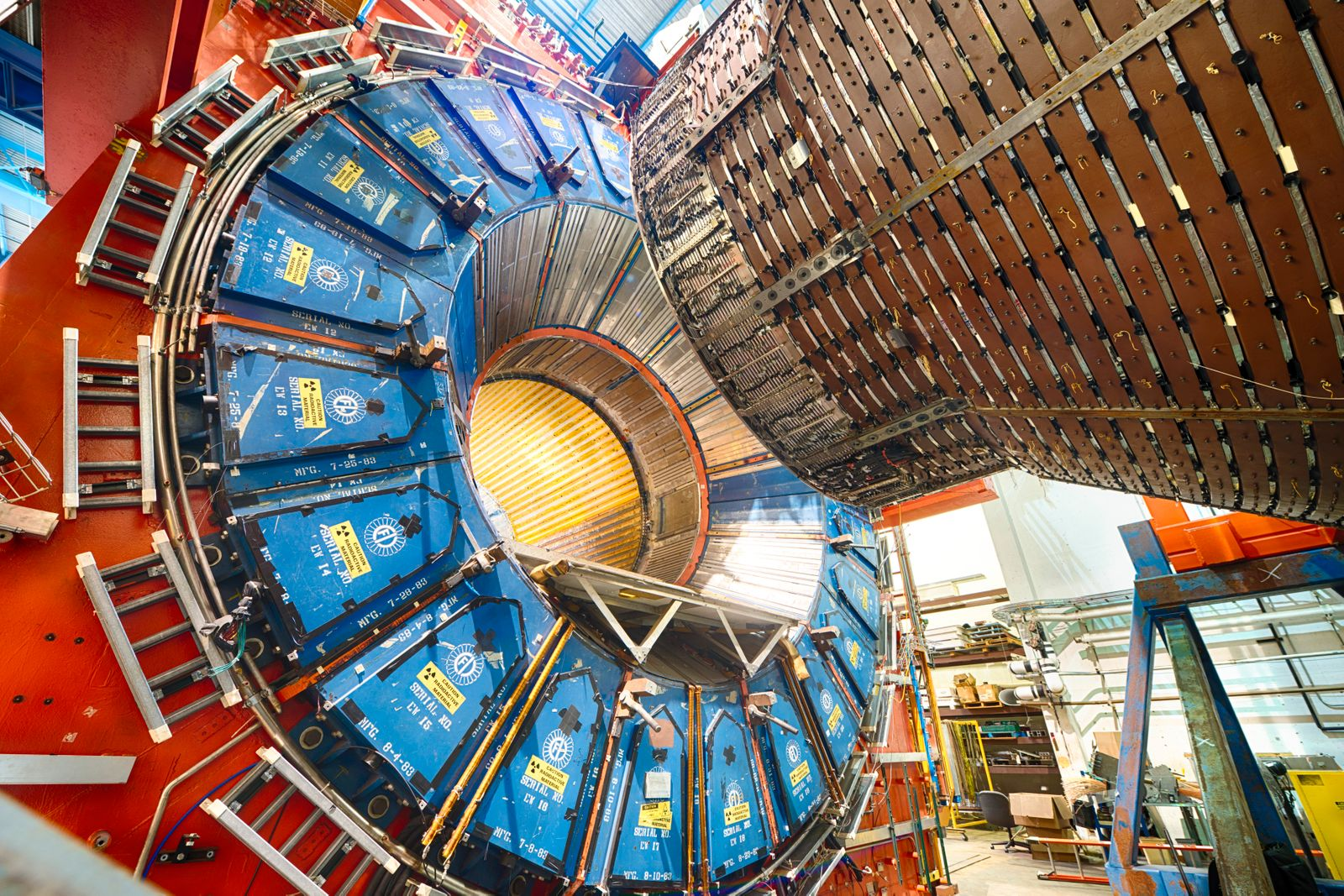 |
| The Collider Detector at Fermilab |
Working off my backlog of imaged deep space objects, I present the Spider and the Fly in narrowband and broadband combined. Well, if you pay attention to the dates of acquisition it really wasn't part of my backlog :)
This image was a bear to process as there were some high clouds present while I captured the Oiii and Sii data. This caused significant background noise in the image and I had to really push the noise reduction in my post-processing. Not too happy with the result, but here it is anyway.
 |
| The Spider and the Fly Feb 27, 28 and Mar 3 GT102 and ASI2600mm Camera f/5.5 10 hours |
Taken over three nights (Feb 27, 28 and Mar 3) for about 10 hours of total integration time.
The Spider is about 10,000 light-years distant while the Fly is a bit closer to us at 7,000 light-years. They reside in the constellation Auriga. Composed of clouds of gas and dust, this region is the site of new stellar birth. The glowing nebula is caused by the excitation of the gas by clusters of massive, relatively newly formed, stars located near the centers of the nebulosity. The large nebula on the right side of the image is the Spider and the small nebula is the Fly.
Full details at: https://www.astrobin.com/8y5xan/
C/2021 O3 (PanSTARRS) is an Oort cloud comet, discovered on 26 July 2021 by the Pan-STARRS sky survey. It will come to perihelion (closest approach to the sun) on 21 April 2022 at 0.287 AU (26.6 million miles) from the Sun.
As far as calculations go right now it appears that it might reach apparent magnitude 5 by late April 2022, but will only be 15 degrees from the Sun, low in the western sky. Binoculars will be needed to see it in the bright dusk sky. C/2021 O3 will make its closest approach to Earth on 8 May 2022 at a distance of 0.60 AU (56 million miles). As a dynamically new comet from the Oort cloud there is a high risk that this comet may disintegrate after passing perihelion as comet ISON did back in November 2013.
Gideon van Buitenen has a web page with some really detailed information (as well as a great animated orbit plot) of C/2021 O3. Worth a look. I'll be keeping a close account of this comet in the weeks to come. Stay tuned.
After an extended period of poor weather, the sky was beautifully clear last night and into the early morning. I had planned to record the o...


