Saturday, June 20, 2020

A Globular, a Star Cluster and Three Galaxies

The new mount is performing admirably. Still a few items to take care of and calibrate, but the full functionality is working just fine.

First up is M68. Messier 68 is a globular cluster in the equatorial constellation Hydra. It was discovered by Charles Messier in 1780. William Herschel described it as "a beautiful cluster of stars, extremely rich, and so compressed that most of the stars are blended together". His son John noted that it was "all clearly resolved into stars of 12th magnitude, very loose and ragged at the borders". (Wikipedia)

M68 Globular Cluster in Hydra
EdgeHD-11 / ASI1600mm camera
40x10sec Lum

This monochrome image was taken on May 31, 2020, with my EdgeHD-11 and ASI1600mm camera. A combination of 40 luminance subs using very short exposures (10 sec).

Next is M88, a spiral galaxy in the constellation Coma Berenices. Recent analysis puts it at about 61.94 million light-years distant. It was discovered by Charles Messier in 1781. M88 lies in the thick of what is called the "Realm of Galaxies", and is among the brightest of the spiral galaxies in the Virgo cluster. The full extent of the disk, about 125,000 light-years across is dominated by dust all the way to the core of the galaxy.

M88 Spiral Galaxy
EdgeHD-11 / ASI1600mm camera
100x60sec Lum; 50x60sec RGB

This photo of M88 was imaged between June 8 and June 10, 2020. At 2.5 hours total integration time, it is composed of 100x60sec L subs and 50 each of 60sec RGB subs.

Next up are two elliptical galaxies, M49 and M89. Elliptical galaxies are a type of galaxy with an approximately ellipsoidal shape and a smooth, nearly featureless image. They are one of the three main classes of galaxy described by Edwin Hubble in his Hubble sequence and 1936 work The Realm of the Nebulae, along with spiral and lenticular galaxies. (Wikipedia)

M49  is located about 56 million light-years away in the equatorial constellation of Virgo. This galaxy was discovered by French astronomer Charles Messier on February 16, 1777 and was the first member of the Virgo Cluster of galaxies to be discovered.

M49 Elliptical Galaxy
EdgeHD-11 / ASI1600mm camera
100x10sec Lum

M89 is another elliptical galaxy discovered by Charles Messier on March 18, 1781. It is also located in the constellation of Virgo, about 50 MLY from earth. It is nearly perfectly spherical.

M89 Elliptical Galaxy
EdgeHD-11 / ASI1600mm camera
100x10sec Lum

Finally, an open star cluster, M18. This cluster of stars, in the constellation Sagittarius, was discovered by Charles Messier in 1764. It is relatively close lying at about 423,000 light-years distant. It is a sparse cluster about 26 light-years across. This image was taken on June 13, 2020.

M18 Open Star Cluster
EdgeHD-11 / ASI1600mm camera
20x10sec RGB


Monday, June 15, 2020

Busy "Day" with the EdgeHD

Yes, the emphasis is on the word 'day'.

One of the unique capabilities of the Astro-Physics mount is that it can allow you to start your imaging session in the east with the counterweights UP.  Now that probably doesn't mean a whole lot to those of you who are not astro-nuts like me (and there are others of course who do get it). But one of the scary times of a long evening's imaging session is when the scope passes the meridian.

The meridian is an imaginary line that extends across the sky from due south to due north. It is the point where a German equatorial mount has to stop tracking, flip completely around to the other side of the pier, re-acquire the object it was tracking and then continue. Now I have had a relatively good success with my meridian flips. But even when they work you lose some precious imaging time while the scope re-acquires the object, and because the camera is now also flipped the post-processing gets a little trickier. When they don't work, the telescope stops tracking and you are done for the evening (if you are in bed).

But the Astro-Physics mounts allow you to start in the east with counterweights up, thus not requiring any flip. But there is a problem with this scenario - with the telescope essentially upside down the camera can find itself dangerously close to hitting the pier (or equipment that might be mounted on the pier). It has the issue when you are trying to image at high declination values (for you non-astro-nuts), that means directly overhead or to the north. So, we need to make sure that doesn't happen.

Astro-Physics APCC Users Guide

And that is what I did today. During the cool of the evening, while it was still light outside, I mapped out the whole allowable movement space of the mount for each declination 5 degrees at a time. With that data the mount has a mapping of the sky where the telescope is free to move without fear of striking the pier. A safe-zone so to speak. Took a bit of time, but well worth the effort.

Now, if only the skies would clear so I can try out this new capability.

Friday, May 29, 2020

Supernova in M61

Earlier this month I spent some time installing my Off Axis Guider (OAG) on the Edge11.  With new spacers I was able to get the OAG to work pretty good.  I was still having issues with the FOV and sensitivity of my guide camera though and so finding a star and guiding was still problematic.  I since purchased a new guide camera based on reviews and comments of the folks on the forums I frequent - the ZWO ASI174mm. This camera has solved my OAG problems of getting decent stars to guide on.  Alas, the clouds rolled in and I have not been able to image anything with the new OAG setup.

But, back on May 13 when setting the spacers I was able to capture M61, a spiral galaxy in the constellation of Virgo. I was using this field of view as my test view for getting the focus on the OAG worked out.  Although I did process the image later that night, the focus was still a bit off due to terrible atmosphere conditions, but I still wanted to get the RGB stack processed to show the supernova (SN 2020 jfo) that appeared in the galaxy.

Here is the image showing the galaxy (cropped up close) with the supernova marked. The power output of an exploding star is immense. This star (or what's left of it) is almost brighter than the entire core of the galaxy!  The other three bright stars are foreground stars in our galaxy between earth and M61.

M61 with SN 2020 jfo
Edge11 and ASI1600mm RGB 20x60sec each

Wednesday, May 20, 2020

The Magic of Image Processing

The Magic of Image Processing - Part I

Over the years I have been asked by friends to explain how I get my beautiful astro-photos, especially from a light polluted sky near Baltimore.  Well, the actual process is pretty complicated and sometimes intense, both in the time and effort put into it as well as the techniques used.  But I'll try to outline the basic steps.

Please note that it is not my intention to provide a detailed account on how this is all done by providing the complete steps, but just to give an overview and high-level look at the workflow.  Part I of this post will cover the capturing of the data and the initial calibration and stacking to get a single master frame.

For this example I am using a section of the Leo Triplet image that I posted on Astrobin back in March of this year (see image above). In particular, M65, an intermediate spiral galaxy about 35 million light-years away in the constellation Leo. In the image it is the galaxy in the lower left.

First step, of course, is to actually photograph the object.  Although this is not part of the post-processing effort, without it there would be nothing to process!  The original photo is a combination of RGB and L subs (subs are the individual photos - many are stacked in the post-processing to create the final image). For the purpose of this discussion I will be using only the luminance subs (monochrome; no color) to make matters a bit simpler. I will be using 64 of the original 70 L subs, each one taken with an exposure of 120 seconds.  Images were taken through my 4", GT102 APO refractor with a ZWO ASI1600mm cooled monochrome camera.

Once we have a good set of raw photos (no star trailing, out of focus, airplane trails across the image - yes, happens a lot) they go through three steps: calibration, registration and integration.

Calibration

Images (subs) of our object are known as lights. Since these raw subs contain additional data that we do not want they must be calibrated to remove, or largely minimize, the bad signal from the good signal. What are the bad signals? Thermal noise from the camera itself, uneven light across the field of view and electronic read noise are the three basic ones.

The thermal noise is due to the fact that heat from the camera itself builds up and triggers the sensor just as light does. With exposures sometimes exceeding 5-10 minutes per sub this buildup can be rather large. And since the amount of signal is proportional to the temperature of the sensor, the higher the temperature, the more heat signal the sensor collects. This is mitigated to a large extent by cooling the sensor and most astrophotography cameras are equipped with thermoelectric coolers. My camera is typically cooled to -20 degrees Celsius (-4 degrees F) even in the summer.

Uneven light is the vignetting of the image due to the optics of the telescope/camera combination. The intensity of the light fades off as it approaches the edge of the sensor. In addition, dust particles on the sensor glass (and filters) produce faint halos and spots (dust bunnies) on the image.

Then there is the noise produced by the very process of reading the data from the sensor.

Calibration is the process of removing as much of this unwanted data as possible.

To remove the thermal noise, special subs, called darks, are taken which are used to remove the thermal noise from the original lights. These dark frames are subs with the same exposure times as the lights but with the sensor closed off to any light. The signal contained in these dark frames is therefore only from the thermal noise. If we subtract the darks from the lights we get a resultant sub that has the thermal noise removed. This process relies on the randomness of thermal energy and is too complicated to fully discuss here, but you get the idea.

The unevenness of the light frame is corrected by the use of a flat. Flats are subs taken through the telescope in the same configuration as when it was taking the original lights. A uniform light source (the daytime sky through a tee-shirt, or an electroluminescent panel) is used to make sure the sensor receives just the view of the optical train with no subject matter - nice uniform, even light. These flat frames, which contain only the dust shadows and the fall-off along the edges, are then used to correct for the vignetting and shadows by dividing the data on the light by the flat data. Again, a bit complicated.

Finally, bias frames are taken to subtract the read noise from the image. These are taken with no light and exposures of as close to 0 seconds as possible as we only want the information produced from the camera's electronics in reading the data off the sensor. These bias frames are then subtracted from the lights as well. In the case of my particular camera, I don't use bias frames, but use dark flat frames instead. Again, too much to discuss for now.

The following diagram may help to visualize what is taking place.

Deep Sky Stacker

I typically create about 40 dark frames to create a single master dark; about 20 dark flats, and 20-25 flats. Multiple frames are taken to reduce the random noise within these calibration frames and produce a more even image.

With my darks, dark flats and flats ready to go I can now calibrate the 64 lights of M65 using a program called PixInsight, my software of choice. This same program will also be used post-calibration to complete the images.

Registration

Registration is the process of aligning each of the calibrated lights to a reference frame so that they all line-up together. Although the telescope is tracking the object closely during the exposure, it is not perfect. And it is actually desirable not to have every frame line up perfectly. I intentionally move each image a small amount when taking the exposures in order to further randomize the noise and other unwanted signal data. This process is known as 'dithering'. 

Integration

With all the light frames now fully calibrated and registered its time to combine them all into one master frame. This is the process of 'stacking'. You might have been wondering why we don't just take a single long exposure shot of the object. There are lots of reasons. Remember in the discussion above how the sensor temperature plays into all this? A single 60 minute exposure would produce a lot of thermal signal (probably too much to eliminate). And then there is the guiding. Even a high-end quality mount might not be able to track precisely enough over an extended amount of time (although with accurate polar alignment in a permanent observatory it probably could). Finally there are the other annoyances - i.e., 18 minutes into a 20 minute sub an airplane passes right through the field of view, producing those 'lovely' bright light trails over the image! For these reasons, and one more 'big' reason (to be discussed really soon), we typically take lots of smaller exposure subs and then combine them to get the final image. In other words, take 60, one minute subs instead of one, sixty minute sub.

So, what's that other big reason?

Thankfully, because of the nature of the universe, the way God created it, noise is random. Every time you take an image the information on the camera sensor that was due to thermal and other forms of noise is a little bit different than in the previous image. Over time it averages out to a certain quantifiable level, but every pixel on a frame, and every frame, will have differing levels of brightness - the actual signal from the object (what we want) and some random amount of signal from the noise (what we don't want). Since the object's signal is constant, and not random, the contribution of total energy from the object builds up as you might expect - one unit of signal multiplied by ten frames equals 10 units of signal. But since the noise is random, multiple frames produce a final total noise energy that does not add up uniformly. The contribution due to noise will be slightly less. How much less? Proportional to the square root of the number of frames less. This means that if I double the number of subs, the real signal increases by 2 but the noise increases by 1.414 (the square root of 2). One way to measure this is by calculating the SNR, or signal to noise ratio.

Astrophotographers pay particular attention to the SNR. This is simply the amount of signal divided by the amount of noise. The higher the SNR, the better. So, for example, lets say a sensor pixel picks up 100 photons of light every second. In one second the SNR would be:
But if we expose for 100 seconds (or the average of ten 10-second exposures) we would get a SNR of:
The higher the SNR, the better the final image will be. Therefore, more subs are better than a few subs. In fact, it is not uncommon for astrophotographers to take 60-200 subs (of each filter) to get the final photo.

OK, enough words and theory, lets see what this all really means.

Here is a single light frame of M65 (120 seconds at f/5.6):


Hmmm, not much showing up!  Where's the galaxy?

Well, it's there, just hard to see. Why?  Because most of the signal is buried deep in the low end of the image spectrum. This object is rather dim, and so there isn't much signal to capture in 120 seconds.

We are going to detour a bit from our processing discussion to discuss how digital cameras work as this is necessary to understand some of the processing techniques.

For simplicity let's imagine that the pixels on a camera sensor are little buckets. Each bucket can only hold so many electrons. As a photon of light strikes the sensor, an electron is created and is stored in the bucket. My camera, for example, has a sensor that can have data values from 0 to 4095. This is called the dynamic range of the sensor. My buckets can hold up to 4096 electrons.

Now, the higher the data value in a bucket, the brighter the pixel in the resulting photo. Buckets that are empty will produce a totally black pixels in the resultant photo. Buckets that are partially filled will produce varying shades of grey.  And, if a bucket fills up completely, you get pure white.

If I was to take a photo of the moon, or some other bright object, the pixels on my camera will fill up pretty fast. And, there would be some that have no data (dark areas) and some that have lots of data (light areas) and some that are in-between.  In a completely white, overexposed frame, every bucket would be full (4095 electrons). But in the case of dim objects like galaxies, nebulae, dust clouds, etc., even after exposing the sensor for minutes at a time most of the buckets only fill up a little bit.

So, in the single sub above, the vast majority of buckets have near zero data values (dark space) and only a few have maybe 10-500 electrons in them. So the range of the data in the image is only 0-500 out of the possible 4095. My buckets are only about 1/8th full at best. That's why the end result is pretty unimpressive. The few pixels that have information in them only produce very dark shades of grey, with a few producing some brighter whites.

But what if we multiply each pixel/bucket value by some factor so that each bucket appears nearly full.  In the case of the image above, since the largest bucket amount is only 500, if we multiplied each by 8 we would end up with buckets that are filled, or nearly filled, and therefore would create a photo where most of the pixels (that at least contained some electrons) would now have much larger values and therefore appear brighter.  We essentially do just that, by a process known as stretching. It isn't as simple as multiplying every pixel with a single value, as the stretch is usually non-linear, but for simplicity the analogy works.

Here is the result of stretching the single light sub.


And there's the galaxy!

But, there's all the noise too.  Since we amplified all the sensor data, the noise was amplified as well.

Now, back to the main discussion.  Here's where the stacking comes in. Remember how we discussed the fact that noise grows slower than true signal?  We use that concept to get an image that contains a lot of data, but over many light subs instead of a single long sub. Thus, we can 'eek out' good data and limit the bad - the SNR gets larger.

The following set of images show progressively larger stack sizes starting with 4-stack and ending with 64-stack; each one twice as large as the previous. You can see how the actual galaxy gets brighter, more detail starts to show and the noise goes down. Note that these have been stretched so you can see the images, but the actual stretching process occurs later in the post-processing steps.


We now have a good master image made up of 64, 2 minute images. The resultant master is basically equivalent to a single sub of 128 minutes, but without the huge amount of noise that a single image like that would have.

In Part-II I will show how we take the master light out of the calibration and integration step and using PixInsight's post-processing routines reduce the remaining noise, enhance the image's detail and adjust the overall quality of the final image. I'll also discuss how color is added to the final image.

Monday, May 18, 2020

Cool Video

I can't recall how many times I've had to explain why chemical rocket technology is not going to get us beyond the local solar system.  Although not the point of this simulation/video it does illustrate the point that the vast percentage of rocket mass is the fuel.

Check it out; it's really pretty well done.

If Rockets were Transparent


Monday, May 11, 2020

More Image Processing

After a good deal of research (and lots of trial and error), I think I have finally got the knack of the new post-processing image process nailed down - at least for now. So, for your viewing pleasure, here are three more DSOs (Deep Space Objects) that I imaged a few months ago and just reprocessed.

First up is the Christmas Tree Cluster and Cone Nebula. Imaged back in February of 2020, this is the result of 15 hours of integration time (60 subs, each 300 seconds, of each filter). Processed in the Hubble Palette (Ha, Oiii, and Sii).

NGC 2264 - Christmas Tree Cluster and Cone Nebula
WO GT102 APO f/5.6 with ASI1600mm Camera
60x300sec each filter
Next is a small reflection nebula near the open cluster NGC 6823 in Vulpecula. The reflection nebula and cluster are embedded in a large faint emission nebula called Sh 2-86. The whole area of nebulosity is often referred to as NGC 6820 (Wikipedia).

NGC 6823
WO GT102 APO f/5.6 and ASI1600mm Camera
20x300sec each filter

Finally, the famous 'Cygnus Wall'.  This is actually a small section of the larger North America nebula (NGC 7000). This image is a combination of the standard SHO palette but with RGB stars added. In the previous two images, the stars appear basically the same color (mostly white) and with a slight purple tint as the narrowband data does not reproduce the star colors correctly. To eliminate this problem I take an additional set of subs in the standard Red, Green and Blue filters with much shorter exposure times to just capture the stars. I then remove the stars from the SHO image leaving just the nebula and add in the stars captured in the RGB data.


The result is a narrowband nebula with correct colored stars. It turns out that I actually overexposed the stars and so they are a bit bloated and not as colorful as they could have been. Later this year I'll retake the stars, add more data to the NB image and recreate the final.

The Cygnus Wall
WO GT102 f/5.6 / ASI1600mm
26x300sec NB;  20x60sec RGB

Saturday, May 2, 2020

A New Comet and A Try at the Rosette

It's official, comet ATLAS has fragmented, and in multiple pieces - dozens of pieces in fact. Once touted as potentially being the comet of the decade it now appears that it will fade out as the days go by.

The Hubble Telescope took these pictures on April 20th and 23rd. As you can see, the once glowing ball of icy rock is now a mess of broken pieces. (See the article in Astronomy).

NASA, ESA, D. Jewitt (UCLA), and Q. Ye (University of Maryland)

I would have liked to get a close up image of the comet with my EdgeHD, but the skies just wouldn't cooperate.

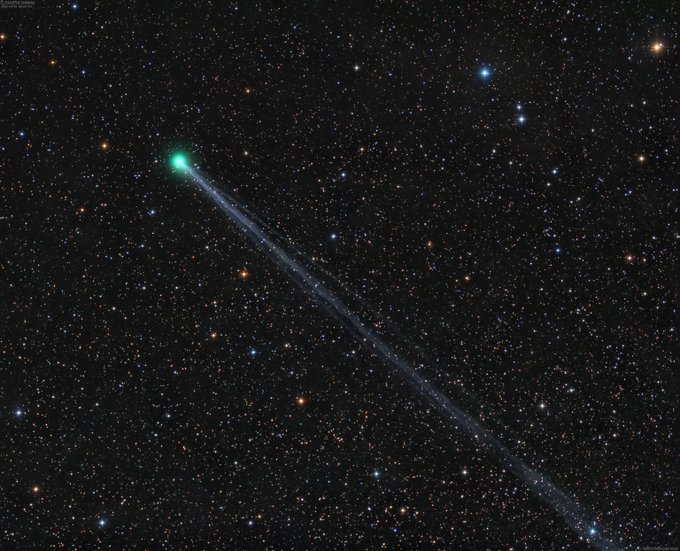
But, although Comet Atlas is no more, Comet Swan looks like it will take over the limelight and is ready to become the “best naked eye comet of 2020.” 

Officially designated as C/2020 F8 (SWAN), it has already brightened sufficiently to be seen by the naked eye - and it's sporting a long thin tail. Damian Peach, noted planetary photographer from the U.K., has taken this photo on April 28th. He stated on Comet SWAN's Twitter account (#Comet) "the tail on this is now at least 8 deg long! The best comet I've seen in some years! 200mm F2 lens with FLI CCD camera."

Image

Bad news for us up here in the northern hemisphere -- Comet SWAN is a southern hemisphere comet. But in late May we should be able to spot it low in the NW just after sunset if the estimates of it's brightness pan out. I'll be posting more info later this month.

With the clouds putting the kibosh on any imaging from Mikey's place the past week, I had some time to process data I captured on the Rosette nebula in narrow-band that I took back in early March with my GT102. The processing gave me fits and it took three attempts (redoing the entire process over from the start) to get it right. Well, as right as I can make it at the present. I'm trying to determine what in the process is not working as well as it could to reduce the noise in the final image. Once I do that I'll probably go for a forth attempt :)

The Rosette Nebula in Narrow-band
March 8 and 9, 2020
GT102 and ASI1600mm Camera -- Just under 6 hrs integration time
'Till next time ...

Mikey


Friday, April 24, 2020

New Mount Operational

After about 2 weeks of setting up, configuring software and testing, the new Astro-Physics AP 1100GTO mount is now fully operational.  There are still some options that I have not yet turned on, but all the basic functions are now working. The EdgeHD11 main scope is now back in service!


The Pier stands 54" tall.  Loading and unloading the OTA is a chore, but manageable provided I keep a close look at the step-stool I use.  I just received a better step-stool from Lowes that should make this all a bit easier. You don't want to slip and fall carrying a $3500 optical tube that weighs in at about 35lbs.

The Astro-Physics GTOCP4 (with APCC software) is mounted on the south side of the pier. It controls the mount itself and all the specialty operations that the mount is capable of performing.  It can operate standalone with either Ethernet or WiFi, so apps like SkySafari can control the scope directly.


On the north side is the Computer and Power Distribution assembly which contains the mini-computer, dew heater controller and the power distribution panel.


The MinisForum GN34 mini-PC (right side) controls all the equipment (cameras, filter wheel, guide scope camera, the mount, remote focuser, etc.) and has all the astro-software needed for astrophotography (Stellarium: planetarium software used to select and command the scope to target a specific object; SGP Pro: the image capture suite which is the main application that controls all the equipment; and a host of other apps.) It has an Intel Celeron J3455 processor, Intel HD graphics 500, 6GB LPDDR3 memory, 64GB eMMC storage, IEEE 802.11ac Dual Band WiFi, Bluetooth and Gigabit Ethernet. Features three USB3.0 ports, SD card slot and both HDMI and VGA ports. This is connected to a gigabit switch in my barn via a 100' network cable. The GN34 comes with Windows 10 Pro and so I control it via a remote desktop connection from any of my computers or mobile devices.

All the 12v power for the system (except for the AP1100 which has a dedicated 12v PS) is distributed via a West Mountain Radio RIGrunner 4008 power distribution panel from Powerwerx. Power is obtained from two Pyramid 12v power supplies, one for the mount and one for all the other equipment.  The power cables on all my devices have been modified to use Powerpole connectors which go right to the RIGRunner. No more lost power due from the cheap car cigarette lighter plugs!

The Dew heaters are controlled by a Kendrick DigiFire 7 controller.

For expansion purposes (like when I run my QHY10 Camera) there is a 7-port powered USB hub mounted to the side of the power assembly.  The MicroTouch focuser controller sides along the hub.


Both the GTOCP4 unit and the Computer and Power Distribution assembly can be easily removed and brought inside to protect them while the mount itself remains outside covered in a Telegizmos 365 Series Cover.

On April 22 the first EdgeHD image was taken with the new setup.  This is an elliptical galaxy  in the constellation Coma Berenices. Taken with the ASI1600mm Pro, this LRGB image was just over 1.9 hours of total integration time.  To the left is NGC4394, a SBb barred spiral galaxy.


I expect to be taking lots of new images of dim, distant objects now that I have a mount up to the task. All I need now are clear skies :)

Friday, April 17, 2020

More Testing of the AP-1100GTO

Taking advantage of the nice day yesterday, I continued with testing the new mount.  I need to route new cables but the cables and power distribution box aren't going to arrive until Friday (today).

During the test I decided to put the planetary camera on the GT102 APO. Now the GT102 doesn't have a long enough focal length to take good images of the planets. For that I need the EdgeHD-11 SCT, which is my big scope and the reason for getting the new mount. But what the heck - I decided to image Venus since it is currently very bright and rather large in size. Should be easy to image even with the APO.

Now since the mount has not yet been aligned precisely to the north celestial pole, gotos would be off by as much as a degree or more. And, since it was daytime finding Venus took a bit of time. But find her I did and got the following image. Not great, but not all that bad either. By the way, Venus has very little surface detail so I didn't expect to see anything but the crescent moon-like image.

Venus 4/16/2020 4:16 PM
GT102 APO with ASI120mc Camera


Tomorrow (Saturday) the cables and power distribution box will be installed. Then, weather permitting, another test with the new cabling will proceed. I'm still waiting for the PoleMaster adapter to arrive which is needed to fully align the mount. Not sure why it's taking so long to get here. Need to check my vendor.

Thursday, April 16, 2020

New Mount setup progressing

On April 2, 2020 I finally decided to 'pull the trigger' and acquire a new, observatory grade mount to replace my ailing CGEM -- the Astro-Physics 1100GTO. Last Friday nine of the ten boxes arrived (the scope attachment hardware arrived on Monday. Took about a couple of days to get all the hardware checked out and the software loaded and tested.

When the Dovetail Plates arrived on Monday I attached the WO GT102 and tested it inside my barn.


Last night, the new mount (with the smaller GT102 OTA) went out under the stars for an initial test run.


So far this mount is proving to be all that was advertised.

Sunday, April 12, 2020

Comet ATLAS is Breaking Up

Apparently, breaking up is not hard to do (sorry Neil), at least not when it comes to comets. With the hopes that Comet ATLAS would be the comet of the 20's, this recent news from the Virtual Telescope Project 2.0 makes that pretty unlikely.

After a number of observations of the inner coma of this comet, the team(s) at VTP observed at least three fragments, telling the comet really experienced a breakup event. Here is the telltale image.


What this all means for what may lie in the future is anyone's guess. Could the remaining larger piece still produce a naked-eye visual object with or without a tail? Maybe. But in the past such breakups have typically been dire news for any memorable visual event.

More updates to follow.

Exploring Einstein's Relativity - Soldiers Delight Star Party this Saturday (May 16)

  Soldiers Delight Star Party - May 16, 2026 Don't miss the next SD Star Party - this Saturday evening! "From Space-Time to Black H...