Thursday, May 25, 2017

Jupiter - like you've never seen it before!

Credits: NASA/JPL-Caltech/SwRI/MSSS/Betsy Asher Hall/Gervasio Robles
With the first set of science results from the Juno spacecraft, we are seeing a whole new Jupiter.  This image shows Jupiter’s south pole, as seen by NASA’s Juno spacecraft from an altitude of 32,000 miles (52,000 kilometers). The oval features are cyclones, up to 600 miles (1,000 kilometers) in diameter. Multiple images taken with the JunoCam instrument on three separate orbits were combined to show all areas in daylight, enhanced color, and stereographic projection.

Storms the size of earth.  Magnetic fields that are stronger than expected.  A north and south pole that are vastly different from each other.  In the next few months we will learn a whole lot more, and with the Great Red Spot as one of the new subjects for study, the excitement continues.

See Nasa.gov for the complete story.

Monday, May 22, 2017

Re-processed image of Comet Johnson

Using a technique of creating a synthetic flat from the original subs I was able to reprocess the image of Comet Johnson to bring out more detail and almost eliminate the gradients.


Gravitational Waves Are Permanently Warping The Fabric of Space-Time

Researchers have proposed a method for detecting exotic events in physics by looking for the scars they leave behind on the fabric of space.

By identifying how objects like cosmic strings or evaporating black holes leave behind memories of their existence on the Universe, it might be possible to move some rather strange phenomena from theoretical to empirical science.

Complete story at ScienceAlert

Friday, May 19, 2017

Comet Johnson

As promised, here is Comet Johnson from my imaging session on Monday, May 15th.  My light box is still not operating properly so I didn't take any flats to correct for the vignetting and other gradients. That is the reason for the slight ring-like halo around the image. And since I didn't have flats I couldn't stretch the image as much as I would have liked, but the result is not all that bad.
Comet C/2015 V2 Johnson - May 15, 2017
EdgeHD11 w/Hyperstar f/2
50x120sec Subs -20C QHY10

Thursday, May 18, 2017

Comet Johnson C/2015 v2

Monday evening was one of the first clear nights that I was able to actually get out and image some astro-objects.  With comet Johnson high in the eastern sky and the moon out of the way (until at least just after midnight) I setup the Edge11 early to cool down before the image run.

SkyTools recommended over a two hundred 30 sec subs, but I knew that the Hyperstar on the Edge was able to do 120 sec subs without any significant fogging due to light pollution.  So with everything set I started the sequence run of 50 x 120sec subs starting at 10:28 pm, just about 18 minutes after the start of Astro-Dark skies (the time slot recommended by SkyTools).

Of course it wouldn't be a 'Mangieri' night of imaging without some problem cropping up. This time it wasn't the weather, or the mount, or the guiding, but the QHY10 camera.  For some reason it took almost an hour to cool down to the -20C temperature.  It has always completed this cool down in about 10 minutes. Post analysis showed that using the QHYCCD software EzCap (supplied with the camera) completed the cool down at the normal rate. Since I just downloaded and installed the latest release of SGP (my normal imaging software) I suspect that the issue may lie there. Anyway, the evening was a success and I captured 50 nice subs of the comet. The sequence ended at 00:48 am (the extra 40 minutes taken up with downloading each sub to the computer). I tried to use my home-build light box to create a set of flats to improve the post processing, but the light is way too bright to work with the Hyperstar - got to get that fixed.

Since I need some time to process the images, I decided to create a time lapse video of the comet movement among the background stars (accelerated quite a bit!). As the frames progress you can see the ever 'popular' aircraft light streaks! The ugly 'pea soup' sky is because I did not process removal of sky glow (light pollution). It will be removed when I process the still image of the comet.


In the next few days I should be able to post the full color image of Johnson.

Thursday, May 11, 2017

Comet Johnson - I'm almost ready for you

Between the full moon, clouds, daylight savings time, and having to get to my real job on the weekdays, I have yet to capture a decent image of comet Johnson, now visible in binoculars in Bootes fairly high in the eastern sky around 10:00 PM.  Johnson is still brightening and will reach best viewing in early June.

According to weather forecasts (and Clear Outside software) Monday through Wednesday next week should provide some decent sky conditions. The only issues might be a warmer air mass with some moderate humidity.

If you want to try viewing Johnson, look high overhead due east (almost 70 degrees from the horizon) just to the left of the 3rd magnitude star Delta Bootis.  Johnson remains high in the sky most of the evening, but the moon will interfere around 2:00AM.


Starry Night Pro 7
View to the east, 11:00PM - May 15, 2017


Starry Night Pro 7
Enlarged area of Constellation Bootes

Saturday, May 6, 2017

Nice Arrangement of Jupiter's Moons

If you have a telescope that can view Jupiter (and most small telescopes of reasonable quality can) there is a nice arrangement of Jupiter's four largest (and brightest) moons on the night of May 9th. The image below shows the moons at 11:15 PM.
Jupiter and its four moons
May 9, 2017

Even a good set of 20x binoculars will probably be able to see them provided the binoculars are held on a tripod or you happen to have those really nice (but expensive) image stabilized versions.

Thursday, April 27, 2017

Postal Service new Eclipse Stamp

Now here is a novel idea for a commemorative stamp.  The Postal Service will soon release a first-of-its-kind stamp that changes when you touch it. The Total Solar Eclipse Forever stamp, which commemorates the August 21 eclipse, transforms into an image of the Moon from the heat of a finger.  The public is asked to share the news on social media using the hashtag #EclipseStamps.

Complete story at:  USPS News

Wednesday, April 19, 2017

Negative Mass - the world of Quantum Physics gets stranger!

Artist's abstraction (stock image) - Credit: © ktsdesign / Fotolia
Washington State University physicists have created a fluid with negative mass, which is exactly what it sounds like. Push it, and unlike every physical object in the world we know, it doesn't accelerate in the direction it was pushed. It accelerates backwards.

See story at ScienceDaily

Sunday, April 16, 2017

LDRS 36 at Higgs Farm

When I heard that LDRS was coming to MDRA this year I had to come out of my 3 and a half year hiatus in rocketry (having two expensive hobbies can take a toll on your finances).  Although I had planned to attend on Thursday and Friday the weather was terrible and so I modified my plans and took the trip to Price, MD on Friday and Saturday.

Friday wasn't all that much better than Thursday as it turned out.  The winds were up to 20-30MPH and it was cold. I stayed most of the day, but didn't launch anything. I did, however, help a friend get his Level 1 certification, so the day wasn't a total wash.

Saturday was much better. Winds were still a bit on the breezy side but manageable. And the temperature was warmer.

I decided not to prep and fly the largest rocket in my fleet, the Talon-2, as planned, since I didn't like the winds and I was still feeling the effects of my cold that I was trying to shake for the last two weeks. But both the Emerald Fire and Mustang-XL were ready to go.

The Emerald Fire was first up. Loaded with a K805G motor (propellant is a green formulation appropriate for a rocket named Emerald Fire) and a Ozark GPS telemetry head in the nosecone, she raced off the pad for a really nice flight to 3,700 feet. She reached a maximum velocity of 322 ft/sec.

Plan was to capture some GPS telemetry data for plotting on Google Earth, but since I forgot to set the data recorder I got nothing. I guess when you're away from rocketry for over 3 1/2 years you tend to forget a few things - now where was that checkist :)

The Mustang-XL was a pure sport flight and it performed very well. Loaded with a J450 DM motor, the takeoff was loud, sparky and cool to watch. She quickly climbed to 4,700 feet with a maximum velocity of 670 ft/sec before landing off to the right about 2000 feet across Ell Downes road. The rocket was carrying a Trackimo device which sends GPS signals via the cellular network.

Video my two flights is up on YouTube:  Video

LDRS was a huge success, and I enjoyed my time back on the rocket field. According to MDRA there were a total of 713 rocket launches during the 4-day event.

Saturday, March 18, 2017

Comet Johnson

Just got done with the processing of some subs I took of comet C/2015 V2 Johnson on March 3rd.  The fact that the comet was so close to the bright star Tau Herculis (mag 3.9) made it really difficult to get the image processed.  It's not great, but it is in there; green and all! 
C/2015 V2 (Johnson)
March 3, 2017
EdgeHD11 Telescope at f/7   40x180sec subs

Why green?  Many comets have an abundance of chemical compounds such as cyanide (CN2) and carbon (C2). When these compounds are ionized, due to the sun's energy, they emit light in the green spectrum.  Hydrogen (more common) also glows but is much fainter. 

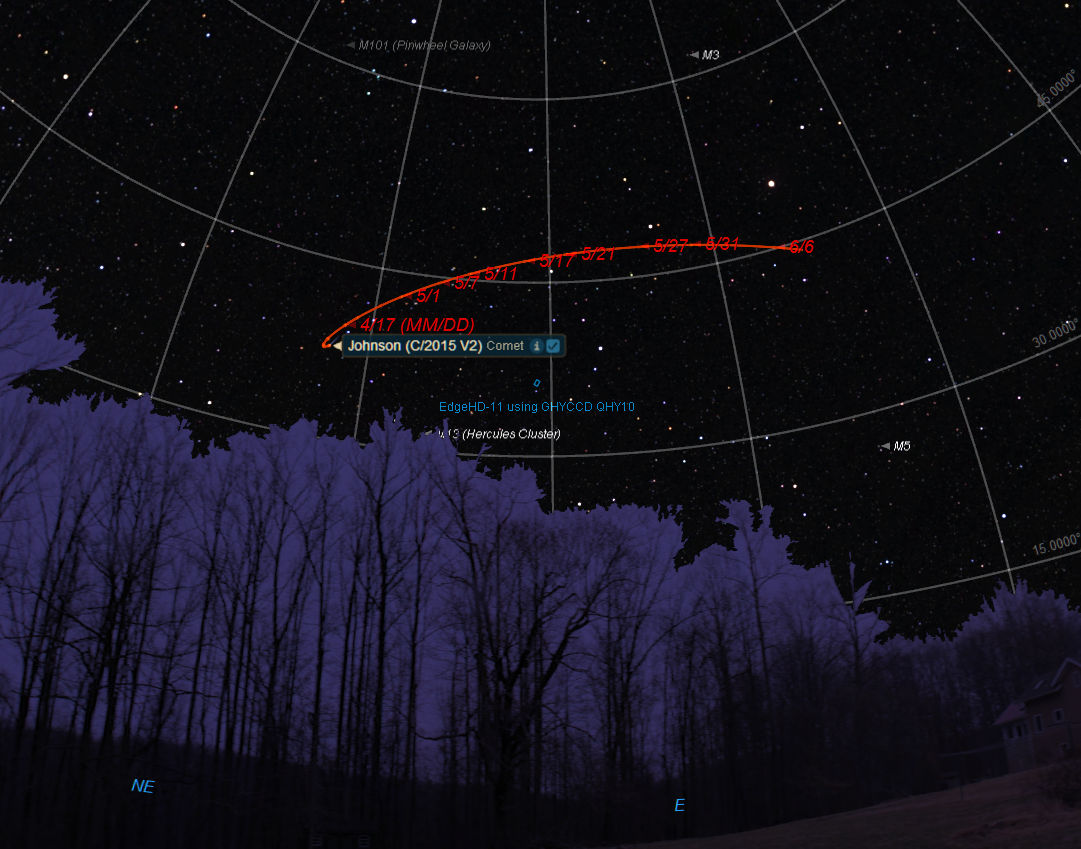
Johnson's orbit really favors us northerners as she will be high in the NE - E over the entire time.  The chart shows Johnson on March 18, 2017 at midnight, with the future positions marked in red.  Note however, that every day the comet actually gets higher and higher due to the earth's rotation and the fact that the comet is following a rather straight path to the west.  It is about 37 degrees up from the eastern horizon right now, but by May 15th she'll be directly overhead at midnight.  So by then you could see the comet the same as now in March but at 9:00PM rather than midnight.

C/2015 V2 (Johnson) is a hyperbolic comet discovered on 3 November 2015 by Jess Johnson (Catalina Sky Survey) at an apparent magnitude of 17.1 using a 0.68-meter (27 in) Schmidt–Cassegrain telescope (Wikipedia).  Since the orbit is hyperbolic, Johnson will not return to our solar system, but after passage later this summer she will head out to deep space.

I'll be imaging Johnson whenever I can.  By June she may even be visible to the naked eye in dark skies.  Certainly visible with binoculars.

Soldiers Delight Star Party - The Role of Telescopes in Astronomy

  Soldiers Delight Star Party - August 15, 2026 Don't miss the next SD Star Party - this Saturday evening! "The Role of Telescopes ...