Now that Odysseus is on the moon, what's in store for the little lander? Check here for the plans, details on the instruments aboard the spacecraft and other info about Odie's mission and the next steps as we plan for humans to return to the moon.
Friday, February 23, 2024

Thursday, February 22, 2024
We're Back!
Odysseus Spacecraft Lands on the Moon
 |
| Odysseus Spacecraft Completes First U.S. Moon Landing Since 1972 © Provided by The Wall Street Journal |
A spacecraft by Houston-based Intuitive Machines landed on the lunar surface Thursday evening shortly after 6:20 PM EST, the first time a U.S. vehicle has touched down there in more than 50 years. The vehicle is carrying six major payloads to be deployed on the moon's south pole region where we expect to find water ice.
Earlier this evening NASA lost contact with the vehicle and it was touch and go for awhile. But all signs are that Odie, as it is affectionally called, is safe on the lunar surface.
This is a developing story with updates to follow.
Sunday, February 18, 2024
Latest Images from Reisterstown
Latest Images from Reisterstown, MD
I was checking out my latest images that I have been working on and realized that I haven't posted here in months! Sometimes you just get so busy that things drop off your list and this was one of them. I had a fairly large number of image runs that I only recently had the time to process. So, time to post my new image captures in the order I processed them, not by date.
The Heart Nebula (IC 1805)
 |
| Heart Nebula - Nov 19-20, 2023 William Optics ZS-61; ZWO ASI1600mm; SHO Palette Integration Time: 6h40m |
The Heart Nebula, also known as IC 1805 or Sharpless 2-190, is an emission nebula located in the Perseus Arm of the Milky Way galaxy. It is situated in the constellation Cassiopeia, approximately 7,500 light years away from Earth, and is part of a complex of nebulae that includes the Soul Nebula (IC 1848). The Heart Nebula gets its name due to its resemblance to a human heart shape. The nebula is approximately 150 arcminutes in size, which is equivalent to 3 times the diameter of the full moon. Emission nebulae are clouds of ionized gas, primarily hydrogen, that emit light of various colors, and in the case of the Heart Nebula, the vibrant red color is produced by ionized hydrogen gas that is interacting with ultraviolet light from nearby hot, young stars (the open cluster, Melotte 15). The nebula is a region of active star formation, and the intense radiation from these young stars causes the surrounding gas to glow. This image was taken in the SHO, or Hubble palette, where the hydrogen gas appears red and the ionized oxygen and sulfur gases, are responsible for the rich blue and orange.
The Heart of the Heart
 |
| Core of the Heart Nebula - Nov and Dec, 2022 Celestron EdgeHD-11; ZWO ASI2600mm; SHO Palette Integration Time: 17h20m |
This image shows the beautiful detail rather deep within the Heart Nebula centered on the open cluster, Melotte 15 -- hence the 'Heart of the Heart'. Taken in the SHO, or Hubble palette, where the hydrogen gas appears red and the ionized oxygen and sulfur gases, are responsible for the rich blue and orange. RGB stars were added in after the starless NB image was processed.
Silver Sliver Galaxy, NGC 891
 |
| Silver Sliver Galaxy - Nov 11 and 12, 2023 Celestron EdgeHD-11; ZWO ASI2600mm Integration Time: 10h |
The only galaxy in the group, NGC 891 (also known as Caldwell 23, the Silver Sliver Galaxy, and the Outer Limits Galaxy) is an edge-on unbarred spiral galaxy about 30 million light-years away in the constellation Andromeda. It was discovered by William Herschel on October 6, 1784. The galaxy is a member of the NGC 1023 group of galaxies in the Local Supercluster. It has an H II nucleus. (wiki)
I remember this galaxy from my days in grade school back in the '60s when I was a avid watcher of the the original Outer Limits series. This was one of the DSO's featured during the ending credits along with the wonderfully eerie music (Dominic Carmen Frontiere).
Sh2-261 Lower's Nebula
 |
| Lower's Nebula (Sh2-261) - Nov 11 and 12, 2023 William Optics GT-102; ZWO ASI2600mm; SHO Palette Integration Time: 16h |
Lower's Nebula, also known as Sharpless 261 (Sh2-261), is a hydrogen emission region located in the constellation Orion. It's located on the edge of the Milky Way, between the Orion and Perseus arms, and is about 3,300 light years away.
A Horse in the Stormy Grey Waters
 |
| Horsehead Nebula and Surrounding Region - Jan 11, 2024 William Optics ZS-61; ZWO ASI1600mm; Ha only Integration Time: 5h5m |
It wouldn't be a winter season without capturing either the Horsehead or Orion Nebula (or both). This year I did the Horsehead. I have the HaRGB (full color) version completed as well but I really liked the Ha only version as I was processing the image - it has such a dark, almost ominous, appearance. The actual 'horse' in this wide field image can be seen in the center of the image.
The California Nebula (NGC 1499)
 |
| California Nebula - Nov 24, 2023, Jan 2,4, 2024 William Optics ZS61; ZWO ASI1600mm; Ha, Sii and RGB Stars Integration Time: 9h |
The California Nebula (NGC 1499/Sh2-220) is an emission nebula located in the constellation Perseus, and its name comes from the fact that it resembles the US State of California. Although it is about 2.5° long, it is not easy to see as it is very dim. However, in Hα light it stands out quite well. It lies at a distance of about 1,000 light years from Earth.
This image was created combining Hα and Sii along with RGB stars. I found no appreciable signal in the Oiii band, which could have been the result of poor sky conditions, and so I decided not to spend the time to capture that wavelength.
Sh2-101 Tulip Nebula
 |
| Tulip Nebula (Sh2-101) - 8/10,11,31 and 9/1,2 2023 Celestron EdgeHD-11; ZWO ASI2600mm; SHO Palette Integration Time: 14h45m |
The Tulip Nebula, also known as Sh2-101, is a large emission nebula located in the constellation Cygnus. It's named for its distinctive shape, which resembles a tulip when viewed from certain angles. The nebula is approximately 70 light-years across and lies about 6,000 light-years away from Earth.
The Tulip Nebula is primarily composed of ionized hydrogen gas, which emits light in the characteristic red color associated with hydrogen-alpha emission. It's a region of active star formation, with hot, young stars embedded within it. These stars emit intense ultraviolet radiation that ionizes the surrounding hydrogen gas, causing it to glow.
The Tulip Nebula is also characterized by dark dust lanes, which are regions of dense interstellar dust that block the light from background stars. These dust lanes often trace the intricate structure of the nebula and are indicative of areas where new stars may be forming.
Taken through Ha, Oiii and Sii filters, and then overlaid with RGB stars. I mixed both 300 and 600 second exposures to help bring out some of the faint Oiii signal, but some additional blue light stretching was still necessary to get the result I was looking for. The NB mix is the traditional SHO palette.
Saturday, September 30, 2023
Asteroid sample returns to Earth / JWST settles the issue: Big Bang still seems proven correct
Nothing new to show in my astrophotography endeavors. With a rare string of clear nights here in Maryland I imaged two new objects, but simply haven't had the time to process them yet. Stay tuned and check back as I plan to have them completed in the next week or so.
 |
| The sample return capsule from NASA’s OSIRIS-REx mission is seen shortly after touching down in the desert, Sunday, Sept. 24, 2023. Credit: NASA |
OSIRIS-Rex Mission
As for other news ... the OSIRIS-REx mission has just completed NASA’s first sample-return mission from a near-Earth asteroid (NEA). The samples arrived at the Utah Test and Training Range (UTTR) near Salt Lake City, where a team of engineers arrived by helicopter to retrieve the sample capsule. All went well and the initial examination of the sample shows some dust and dirt. Now we need to wait until the analysis phase starts and provides data on the composition of the material. See Universe Today for more details on the mission and the return of the sample. Exciting times for sure.
The James Webb telescope sees baby galaxies at the distant edges of the universe and finds they contain very little heavy elements just as the Big Bang predicts. There was a lot of talk over the past weeks about far distant galaxies imaged by JWST appearing too mature for their age. It seemed that something might be seriously flawed in our theory of galactic evolution. But the new spectroscopic data coming in clearly shows the lack of heavy elements as would be expected for galaxies formed in the early years of the universe.
Day Has Returned, but India’s Lander and Rover have Failed to Wake Up
 |
| The Pragyaan rover captured this image of the Vikram Lander on August 30th, before lunar night enshrouded it in its frigid darkness. Image Credit: ISRO. |
It looks like India’s Chandrayaan-3 succumbed to the cold, and its mission is over. The frigid lunar night lasted about two weeks, and a new day has dawned. With that day came hopes of a sunlit revival for the lander and the rover, but the India Space Research Organization (ISRO) says the chances of the spacecraft awakening in the Sun are diminishing by the hour.
The Chandrayaan-3 lander was the first spacecraft to land in the rugged terrain of the Moon's south pole region. It is here where deep craters that never see sunlight might hold reservoir of water and therefore would be an ideal location for manned lunar bases. See complete story at Universe Today.
Saturday, August 26, 2023
The Bubble Nebula
Today I present the Bubble Nebula, NGC 7635, taken over six nights, from July 17 to August 22, with my EdgeHD11 scope and ASI2600mm camera. The best images (those that are very noise free) require a long amount of integration time. I rarely spend multiple nights to get one image with the rarity of clear nights here in Maryland, but I wanted an image that would really stand out.
 |
| The Bubble Nebula - July/August 2023 EdgeHD11 OTA with ASI2600mm Camera 29.5 hours integration time (NB and RGB Filters) |
The Bubble Nebula is 7 light-years across and resides 7,100 light-years from Earth in the constellation Cassiopeia. The "bubble" is created by the stellar wind from a massively hot young central star. The nebula lies near a giant molecular cloud in space (which can be seen across the image as the yellowish-red cloud). The bubble nebula itself is being excited by that hot central star (just to the right of the center of the bubble), causing it to glow. It was discovered in November 1787 by William Herschel.
Here is the Hubble telescope image of the same object for comparison.
 |
| Bubble from Hubble |
Tuesday, July 18, 2023
Some Globular Clusters and a New Project
In early May there was a decent break in the lousy weather we've been having, and even though I'm still having to deal with the Canadian forest fire smoke, I decided to go for some easy captures (well, relatively easy) while I can.
First up is a famous star cluster, Messier 13 (or M13). This cluster of stars is sometimes called the Great Globular Cluster in Hercules or the Hercules Globular Cluster. It contains about 300,000 stars and is estimated to be just under 12 billion years old. It is so dense that near the core there are as many as 100 stars per cubic LY. M13 is about 22,200 LY from earth.
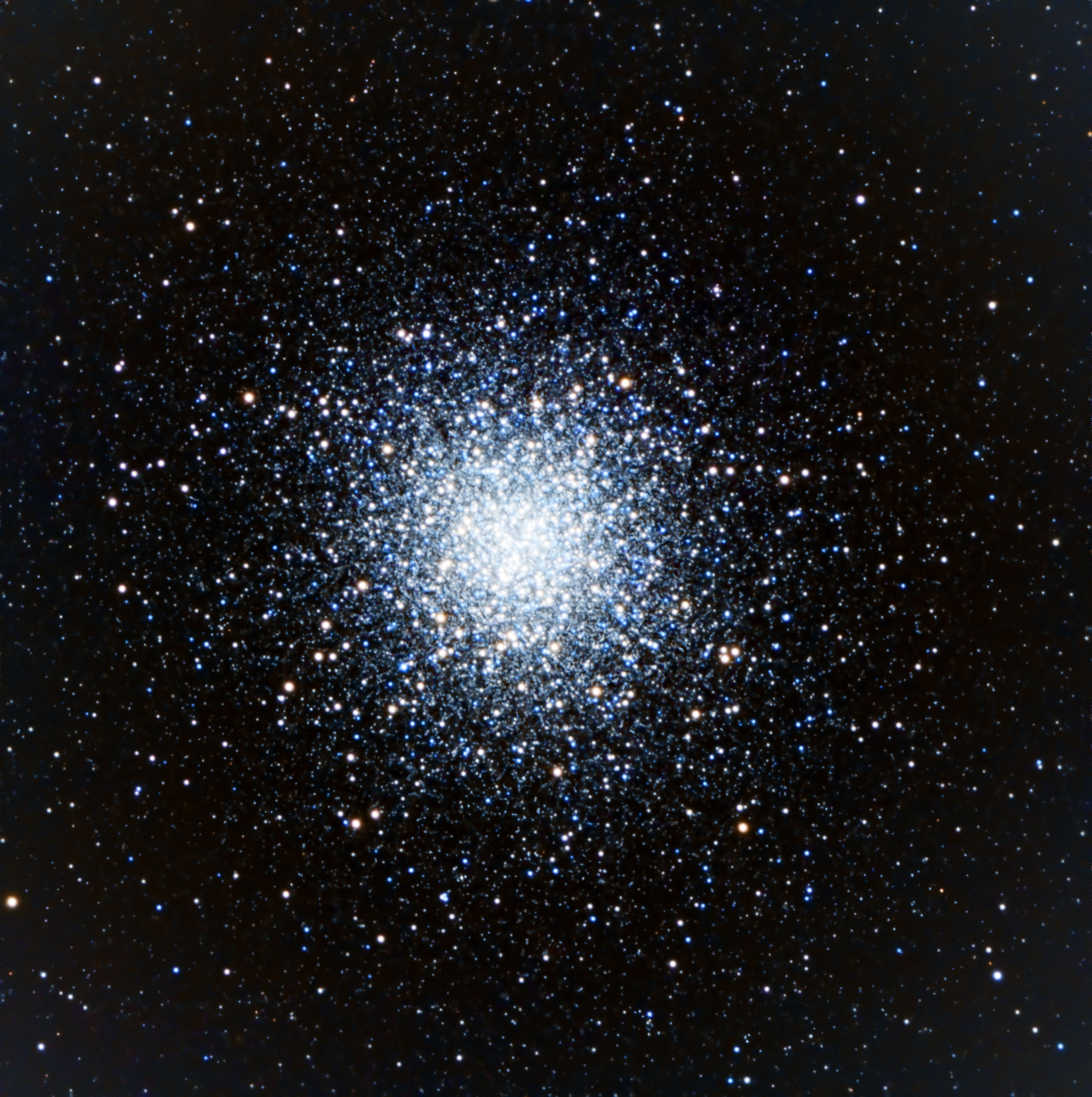 |
| M13 - May 9, 2023 EdgeHD11/ASI533MC - 77×120″ subs |
Second is another globular cluster, M3. This cluster is one of the largest and brightest, and is made up of around 500,000 stars. It is estimated to be 11.4 billion years old. It is centered at 32,600 light-years away from Earth. (Wiki)
 |
| M3 - May 10, 2023 EdgeHD11/ASI533MC - 110×120″ |
I am now planning on a new project which may take a number of weeks to complete. Back in October of 2019 I captured the iconic Bubble Nebula with my GT102 APO refractor and ASI1600mm camera. I was still learning a lot back then (both in capture techniques and processing tools), and although the result was quite good, it lacked the 'wow' factor that I've seen in other images of this deep space object.
With my new equipment (ASI2600mm camera and new Optolong 2" NarrowBand filters) ready I decided to redo the capture of the Bubble Nebula and try to get a better image. This is going to take a bit of effort since I will need about 60 subs (600 sec exposure each) of all three filters. That means I need about 35 hours of capture time (accounting for the exposures and periodic re-focusing time) to get the data I need. I will probably wait to early autumn to take advantage of the clearer skies and the longer periods of darkness. As a test I captured 28 subs (600 sec each) in Ha on July 17 to see how the camera performed. Can't wait to get the whole set of data later this year.
 |
| Test capture of C11 (Bubble Nebula) EdgeHD11/ASI2600mm 28x600sec Ha |
Monday, June 19, 2023
M51 - the Whirlpool Galaxy
Got a couple of clear nights with relatively little smoke so I decided to image the famous Whirlpool galaxy. I haven't taken a new image of M51 since back in 2014, when I just got started in astrophotography with my new EdgeHD11. I used a Canon 50D for that one. So I figured it was about time I captured it with my upgraded equipment and new processing tools and skills.
As usual, sky conditions this year have been abysmal, and even when the sky was clear, the smoke from Canada usually played games with my imaging. But I did manage to get some decent skies on June 14 and 18, so went for it. Turns out that the blue subs had some issues with registration (seems that happens a lot with my objects/subs - gotta check into that). But I decided to process with just the 19 blue subs since the weather isn't going to cooperate any time soon.
 |
| Whirlpool Galaxy (M51) June 14 and 18, 2023 - EdgeHD11 and ASI2600mm LRGB - Total Integration time: 6h48m |
The Whirlpool Galaxy, also known as Messier 51a (M51a) or NGC 5194, is an interacting grand-design spiral galaxy with a Seyfert 2 active galactic nucleus. It lies in the constellation Canes Venatici, and was the first galaxy to be classified as a spiral galaxy. It is between 23 and 31 million light-years away and 76,900 ly in diameter.
The galaxy and its companion, NGC 5195 (reddish galaxy to the left), are easily observed by amateur astronomers, and the two galaxies may be seen with binoculars. The Whirlpool Galaxy has been extensively observed by professional astronomers, and its pair with NGC 5195 who study it to understand galaxy structure (particularly structure associated with the spiral arms) and galaxy interactions. Its pair with NGC 5194 is among the most famous and relatively close interacting systems, and thus is a favorite subject of galaxy interaction models. (Wiki)
Tuesday, June 6, 2023
The Cat's Eye Nebula
Yesterday I promised that I would upload my latest image, the Cat's Eye nebula, and so here it is (with the off-color NB stars - I'll reprocess with RGB stars later when I acquire them).
 |
| NGC 6543 - the Cat's Eye Planetary Nebula EdgeHD11/ASI2600mm - 42x600sec Ha; 43x600sec O3 14 hours integration time May 31, June 2 and June 5, 2023 |
This is the famous Cat's Eye nebula, a remarkable planetary nebula (PN) located in the constellation of Draco the dragon. It was discovered by William Herschel on February 15, 1786. It resides at an estimated distance of 3,262 light years from earth. The inner core is about 16 arc sec in diameter, which at it's current distance would make it about 0.25LY wide. Images from the Hubble telescope made this object a subject of popular review when they showed the central core of the nebula in exquisite detail, revealing knots, jets, bubbles and complex arcs, all being illuminated by the central hot planetary nebula nucleus. My image shows the surrounding outer halo (about 4.7LY in diameter) in the HOO NB color palette. Both the central WR:+O7 spectral class PNN star and the concentric rings surrounding the inner core can be plainly seen. Based on both the estimated distance and the expansion rate the age of this PN is about 800-1200 years old.
The image was composed of 42 Ha subs and 43 O3 subs, each 600 seconds of exposure. Since the nucleus of the nebula is so very bright (shining at magnitude 8) the 600 seconds really washed out the core and so I had to carefully process the image with a High Definition layer routine to bring out some of the internal detail and reduce the overall intensity. There is evidence of some processing artifacts present, but adding more data later will probably resolve that issue. I had also planned to capture RGB stars to replace the NB stars, but between the full moon and the smoke drifting into Maryland from the Canadian fires I had to forgo those and settle on the NB stars. I hope to replace them with RGB stars when I capture more data of this wonderful object.
Monday, June 5, 2023
Smoke in Maryland - And a Feature Article on Your's Truly

Here it is - Monday evening; clear sky, cool temps, low humidity. What more can you ask for? Should be a great night to capture the RGB stars I need for my latest project. But, where are the stars? And what's with Venus, so pink and dim, when it should be brilliant white. Why smoke, of course! Yep, the Canadian fires are filling our skies with a fairly thick haze of smoke. So no imaging tonight. I'll probably process the subs I got of the Cat's Eye nebula without the colored stars. Maybe I'll capture them later and add them in at a later date. I'll post the image later this week.
On another note ... back in March, Photonic Cleaning Technologies, a company that developed a polymer cleaning solution used by professional observatories and industrial optical organizations, contacted me after I had a conversation with one of the owner/engineers about using their First Contact Polymer to clean my telescope optics. We had a great talk about astronomy and astrophotography, and it was soon after that conversation that Debra Giesen emailed me about publishing an article about my hobby on their website. Of course I jumped on the opportunity and started writing the first draft. All I needed to do is agree to include a short testimony on how I liked the Polymer cleaner. Not only would the article be posted on their website, but would be a feature article in the June edition of Amateur Astrophotography Magazine.
Well, things didn't go all that well. The owner/creator/manager of Amateur Astrophotography Magazine is temporarily suspending future publishing until early next year as he deals with some medical issues. He is confident that the magazine will be back in operation in early 2024 and I will be first on the publication list. But the article, "Astrophotography from Light Polluted Reisterstown" is posted on the Photonic Cleaning Technologies website. Check it out.
Monday, May 29, 2023
Supernova 2023ixf in M101
I'm sure many of you may already know of the supernova that occurred in the Pinwheel galaxy, M101. I wanted to capture it as soon as I could but, as usual, clouds prevented me from doing so until May 26, when it cleared sufficiently to get a decent image.
I had taken an image of M101 way back on Dec 28, 2013, when I was just starting out with astrophotography. I had recently acquired my large telescope (the EdgeHD11) and this was one of my first attempts at imaging a galaxy. I didn't even own a dedicated astro camera back then - the image was taken with my Canon 50D body. I'm not sure why I haven't taken a recent image of M101 as it is a wonderful galaxy, but that's another story.
Amateur astronomer Koichi Itagaki discovered it on May 19, 2023. The supernova should remain visible to amateur astronomers with backyard telescopes for a few months. The supernova – named 2023ixf – lies in the direction of the constellation Ursa Major, near the end of the handle of the Big Dipper.
So here is my image of M101 with the supernova marked (and the 2013 image for reference).
 |
| Supernova 2023ixf in M101 May 26, 2023 - EdgeHD11/ASI533mc 40x180sec with UV/IR block filter |
 |
| M101 - Dec 28, 2013 EdgeHD11/Canon 50D 12x120sec ISO 3200 |
You can read more about this object at SkyAndTelescope. Details of my image can be found at Astrobin.
Monday, May 22, 2023
Latest image from Mikey's Place - the Sombrero Galaxy
Since galaxy season is upon us I decided to give the ASI533mc a workout. For those of you who do not know what galaxy season is here is a short explanation.
There is a region in the sky where a significant number (the vast majority actually) of galaxies congregate. As the Earth swings around its orbit in the spring, it faces the plane of the our own Milky Way but at night it faces a part of the sky that reveals what some of us call the Realm of the Galaxies. During the months of April, May and June, several hundred of these galaxies become easy to image with telescopes of 10 inches aperture or more. And, with just a little extra effort, up to thousands can be imaged but will appear rather small as they are much farther distant.
Most of these galaxies are clustered around the constellation Leo the Lion and just beyond Leo's tail. This cluster, some 4,500 or more of them, is known as the Coma-Virgo Cluster and lies about 60 million light years away. This enormous distance is why these galaxies are so faint. Some of these galaxies are larger and brighter than our Milky Way galaxy but still hard to see.
 |
| Sombrero Galaxy - May 11, 2023 EdgeHD11 Telescope / ASI533mc camera 58x120sec subs thru UV/IR cut filter |
The photo displayed here is the Sombrero Galaxy (one of the Messier objects, M104, and also designated as NGC 4594). It lies 31.1 million light years from the Milky Way and is slightly larger in size at about 94,900 light years in diameter (the Milky Way is estimated to have a diameter of 87,400 light years). Because of it's large distance from us it appears in the sky to be only 9' x4' (the ' is a minute of arc which is 1/60 of a degree, making the size about 0.15 degree in the long dimension). It has a very bright nucleus, and a rather large central bulge (which is unusual for galaxies). In addition it sports a prominent dust lane in its outer disk, which is viewed almost edge-on. It is the dark dust lane and the bulge that give it the appearance of a sombrero hat (thus the name).
More details about my image of the Sombrero can be found on AstroBin.
Subscribe to:
Posts (Atom)
Soldiers Delight Star Party - The Role of Telescopes in Astronomy
Soldiers Delight Star Party - August 15, 2026 Don't miss the next SD Star Party - this Saturday evening! "The Role of Telescopes ...
