Saturday, July 31, 2021

Visit to the International Latitude Observatory

Yesterday my wife and I needed to drop off our aging poodle Lucy for dental surgery at the Center for Veterinary Dentistry and Oral Surgery in Gaithersburg. The surgery was to take about 3-4 hours, and so after we arrived at around 7:45AM, we had some time to kill. Our ultimate location was Capital Quilts (directly across the parking lot from the Veterinary Center), but it didn't open until 11:00.

So we headed over to the Silver Diner RIO in the new RIO Lakefront Mall where we had a wonderful breakfast/lunch. We then took in the sights of the small lake/pond, this after I spent 15-20 minutes searching for my car in the parking garage. Turns out I entered from a different side and got disoriented. This is what happens when you reach the senior years!

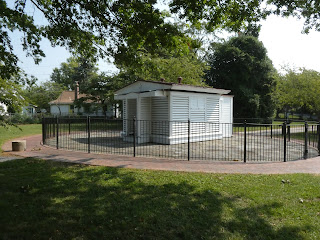
But just prior to getting to the quilt shop, we headed to a small park that Joan had researched as a possible site to visit - an interesting astronomy related site called the International Latitude Observatory. Nestled right in the middle of a small area called Observatory Heights lies the Observatory Park, just across from Gaithersburg High School. A small park, with only about eight parking spaces on the small street, surrounds the International Latitude Observatory. 

Built in 1899 the Gaithersburg Latitude Observatory became part of an international project to measure the earth’s wobble on its polar axis. The Observatory operated from 1899 to 1982, when satellites replaced human observers. It is still active, however, with GPS systems using survey markers installed on these grounds to make periodic course corrections. Fully restored in the 1980s, the observatory building, the meridian mark pier, and the five geodetic monuments scattered throughout the park are listed on the National Register of Historic Places.

Unfortunately (or maybe not) the observatory building was gated off and locked, but it was a nice place to visit. 

View along the Meridian line

The Observatory

Meridian Mark Pier
used to align the telescope


Markers representing one of the other four locations

We finally got to the quilt shop where we both spent some money (amateur astrophotography is not the only hobby that can drain your budget!). I needed some supplies for items I'm designing and sewing for sale in my shop, Maryland Fiber Arts, LLC. Joan picked up some nice yardage as you can never have enough fabric. She creates quilts for sale in the shop.

Lucy was picked up around 1:00 or so, and we headed back home. She is doing fine considering she had ALL her teeth extracted! But she is not a happy camper!! We continue to remind her that recovery will take some time and then all will be good. I'm not sure she is convinced.

Wednesday, July 21, 2021

Hubble is Back!

NASA's Hubble Space Telescope is back in business, exploring the universe near and far. The science instruments have returned to full operation, following recovery from a computer anomaly that suspended the telescope's observations for more than a month.


New images have been downloaded showing some interesting odd galaxies.

See Phys Org for more details on the fix and the new images.

Monday, July 12, 2021

Adding the WO GT102 to the EdgeHD - Tandem Scopes

With the summer nebulae making their return I need to switch to my wide field refractor to capture these colorful deep space objects. Problem is, removing the 11" Edge from the mount requires a bit of effort and then the mounting plates need to be readjusted. Once the plates are done and the GT102 mounted I need to rebalance the scope. If I then decide I need to photograph planets this summer, or even some small planetary nebulae, the whole process repeats, as I remove the GT102 and add the Edge.

Ever since I got the new AP1100 mount I've been toying around the idea of mounting both OTAs in tandem. The mount can handle up to 110 pounds and I figured the two scopes would come in around 60 pounds including the camera and guide scope. That way I could just cover the two scopes when not being used and leave them on the mount. I could then image from either one just by moving the camera from one OTA to the other. A little bit of rebalancing may be needed, but that shouldn't be too hard.

So this past week I ordered a new 18lb counterweight. It arrived last Friday. I then mounted a dovetail plate on top of the Edge, and with two ADM clamps on the WO GT102 it was mounted on top of the Edge. The 50mm guide scope sits atop the GT102. With all the camera equipment attached I needed the new 18lb counterweight as well as my 5lb one to get the whole system balanced. Now all I need is some clear nights to check everything out. 

The only other issue that needs addressing is the cover. The existing Telegizmo 365 cover could work, but it would be a tight fit and would not reach to the bottom of the pier. I contacted Telegizmo to see about ordering a custom fitted cover. I await their response. Based on my measurements a new cover would allow me to keep ALL the equipment (Power supplies, computer, dew controllers, power distribution panel, etc.) out covered and protected.

So it goes. Hopefully, new summer nebulae images will soon be on the way.

Saturday, July 3, 2021

My Attempt at the Pillars of Creation

Back in July and August of 2020 I imaged M16, the Eagle nebula, which contains, at it's center, what has become one of the Hubble telescopes famous images - the Pillars of Creation. I used my EdgeHD11 telescope to close in on the central portion of the nebula where the pillars reside.

The processing of the image took much effort, and every time I completed the final image I was not pleased with the results. 

Last week I tried a new technique for processing these images and together with some new software I was finally able to get a good result. So here is my version of the Pillars of Creation, in narrowband, Hubble palette.

M16 - Pillars of Creation - July/August 2020
EdgeHD-11 at f/11 with ASI1600mm pro
13 hours Ha, O3, S2 Narrowband w/RGB stars added

Complete details can be found at Astrobin

Saturday, June 19, 2021

Hubble Space Telescope in Trouble

June 13, 2021, the Hubble Space Telescope shut down after an issue with a 1980s-era payload computer.
Team members continue to work on the issue to get the telescope operational once again.  (Image credit: NASA)


The Hubble Space Telescope, which has been peering into the universe for more than 30 years, has been down for the past few days, NASA said Friday. The problem is a payload computer that stopped working last Sunday, the US space agency said. "There is no definitive timeline yet as to when this will be completed, tested, and brought back to operational status," the Hubble operations team said.

Full story at Phys.Org and Space.com.

Friday, June 11, 2021

Juno Visits Ganymede

Up close and Personal

The Juno spacecraft flew closer to Jupiter’s largest moon than any other in more than two decades, offering dramatic glimpses of the icy orb.

Credit: NASA/JPL-Caltech/SwRI/MSSS

The first two images from NASA Juno’s June 7, 2021, flyby of Jupiter’s giant moon Ganymede have been received on Earth. The photos – one from the Jupiter orbiter’s JunoCam imager and the other from its Stellar Reference Unit star camera – show the surface in remarkable detail, including craters, clearly distinct dark and bright terrain, and long structural features possibly linked to tectonic faults.

Full story/article at JPL.

Thursday, June 10, 2021

M90 - Galaxy in Virgo

M90 - Spiral Galaxy in Virgo

M90 - May 13-15, 2021
EdgeHD-11 Telescope - ZWO ASI2600mm Pro Camera
LRGB

Messier 90 (also known as NGC 4569) is an intermediate spiral galaxy with a weak inner ring structure. It lies about 60 million light-years away in the constellation of Virgo. The star formation in Messier 90 appears to be tapering off as evidenced by the galaxy's spiral arms appearing smooth and rather featureless. Galaxies with active star formation have knots and trails of knotted groups in their arms. However, the central region does show some significant activity where there exists around 50,000 stars of spectral types O and B (blue to blue-white hot stars) that formed around 5 to 6 million years ago (young).

This image was created by combining 24 blue, 18 green and 17 red subs, each 120 seconds exposure, to get the master color image (RGB). To the RGB image I added 54, 120 second luminance subs (monochrome) for the detail. I had planned to use 30 of each color, but the Maryland weather this year has been giving me fits!

Remember, complete technical details on all my photos can be found on my Astrobin site.

Friday, June 4, 2021

Creating Starless Images

Astro imaging using narrow band filters (Hydrogen alpha, Ha; Oxygen-iii, O3 and Sulphur-ii, S2) is a popular part of imaging. Not only does it enable amateur astro-photographers like me to take images comparable to the Hubble Space Telescope and other land based observatories but they are a great weapon against the ever increasing light pollution we are all experiencing. They are very effective against light pollution because they only allow a very small range of light to pass (hence, narrowband). The NB images are false color as you assign the three colors of the RGB palette to each NB filter. The Hubble palette (SHO) assigns red to the S2 filter, green to the Ha filter and blue to the O3 filter. Another palette I use is the HOO - a bicolor palette as it assigns red to the Ha and both green and blue to the O3 (no S2 data). 

An obvious down-side to NB imaging is that the stars appear highly tinted in largely purple hues because the full range of color is not processed in NB treatment. So, not only is the nebula rendered in false color so are the stars, which makes them somewhat unappealing.

To correct for this I usually image the main subject using the three NB filters and then run a set of short exposure subs using the standard broadband filters to capture the true color of the stars. Then, in post-processing I create two images, one that has all the stars removed, and another that contains only the RGB stars. Then the two images are combined resulting in a NB nebula but with stars of their proper color and brightness. 

Extracting the stars is a fairly easy process that works well. Removing them to create a starless image is much more difficult. Some of the tools I use to remove the stars leave behind artifacts that must be manually corrected, and sometimes not all the stars get removed - especially bright ones that appear bigger on the image.

Recently, a fellow forum member, Steve, over at The Sky Searchers (TSS) forum posted about a multi-step process to remove stars from an image leaving no unsightly artifacts. Although I haven't fully tested it out on multiple images the results are thus far impressive.

Here are the pre- and post- star removal images of the Rosette nebula.


Unfortunately I don't have a set of RGB stars for this image so I couldn't add them back for the final photo (some folks like star-less images standalone). 

I will certainly add in the RGB session on my next NB project.

Thursday, June 3, 2021

Darks vs no darks

One of the features of my new ASI2600mm camera is the low noise levels compared to other cameras. Recall that the 2600's dark frames typically have median ADU values of about 500 (Test of the 2600). And that is consistent over the typical range I use for exposures in my imaging (60-600sec).

Earlier this week I imaged some RGB and Lum subs of M98. Clouds rolled in and ruined the complete set of 60 Luminance subs so all I got was the 20 each of RGB. Not a whole lot of subs to work with, and with short 60sec exposures the amount of data was really low - in fact, only about 20-80 ADU over the noise level of 500.

To make matters worse, my attempts at taking the flat calibration frames produced odd horizontal banding on the images so I couldn't use any flats in my post-processing. Later I found out in my research that the 2600 doesn't like short exposures using a flat panel for illumination. If I had reset the camera gain to 0 (from the 100 I used for imaging) I would have had better results.

So I decided to run a little experiment. I processed each set of 20x60sec RGB subs, one with darks (but no flats) and one without darks (again, no flats). Darks are typically used in processing to calibrate the subs by removing the camera's inherent noise from the images. Since the 2600 has very little noise I wanted to see what I would get if I didn't use dark calibration in the processing.

The results are shown below. The image on the left is the 20x60 sec RGB stack processed normally, but without darks. The one on the right is with dark frames. Neither, of course, had flats, but I cropped the images to remove the vignetting and the dust bunnies weren't obvious in these short exposure images. They look pretty much the same don't they? And indeed, I was just a little surprised at the fact that they did look very similar. The low noise is really a great feature of this camera.

M98 - No darks vs darks
20x60 sec subs EdgeHD11/ASI2600

Now, if we zoom in on the images you can see that the image processed without the darks starts to show some significant noise. The image with the darks is much cleaner. (these images have been lightened to show the background noise better.)


So, I will continue to process with darks and flats. But it was an interesting experiment nonetheless. As for the final image of M98 - although I really want to retake this one with proper exposure times and processing to bring out all the lacking detail and brightness, this image will be used in the M110 contest (award on TSS for imaging all 110 Messier objects). I only have eight more to go!

Monday, May 24, 2021

M62 - Globular Star Cluster

Messier 62 is located in the southern constellation of Ophiuchus. It was discovered by Charles Messier in 1771. It lies at a distance of about 22,000 light years from earth and has a diameter is 110 light years. Its estimated mass is one million solar masses and it contains over 200 variable stars. In 2013, astronomers discovered a stellar-mass black hole in M62, one of the first to ever be found in a globular cluster.

M62 - May 21, 2021
Celestron EdgeHD11 f/10 and ASI2600mm camera
20x30sec RGB subs and 33x30sec Lum


With a Declination of -30 degrees, this was a difficult object for me to capture as it never gets more than 25 degrees above the southern horizon and I have very limited view in that direction to boot. I wanted to capture at least 40-60 luminance subs, but with the limited view and not very ideal weather conditions I settled for only 33 good ones to go with the 20 RGB subs.

This one deserves much better treatment (and longer integration time) but it is on my list for the M110 award at TSS and I don't want to wait another year to complete that contest.

Sunday, May 23, 2021

NGC 6229 - Globular Cluster in Hercules

NGC 6229 is a very distant globular star cluster in the constellation Hercules. At about 100,000 light years away it is one of the furthest clusters from earth (that is, cluster in our galaxy) sitting at the very edge of our Milky Way. The Stellarium planetarium software identifies it as the "Prize Comet Globular Cluster" - possibly because of its distance, and hence small size, it would look like a faint comet head in smaller amateur telescopes.

NGC 6229 - May 21, 2021
EdgeHD-11 f/10 ZWO ASI2600mm
30x30sec RGB; 60x60sec Lum


This image was taken with a 9.8 day old moon blaring in the west and cirrus clouds covering most of the sky. Not ideal conditions, but whenever you get a mostly clear night here in Maryland you try to take advantage of the opportunity as best as you can. Globulars are ideal for image objects in these conditions as they tend to hold up well to the sky brightness and LP. 

Soldiers Delight Star Party - The Role of Telescopes in Astronomy

  Soldiers Delight Star Party - August 15, 2026 Don't miss the next SD Star Party - this Saturday evening! "The Role of Telescopes ...