Saturday, August 29, 2020

The Magic of Image Processing, Part 2 - Selection of Image Subs

In my previous post on the The Magic of Image Processing - Part 1, I discussed the capturing of the data and the initial calibration and stacking to get a single master frame.  It is a well known fact that stacking lots of subs yields better signal to noise ration (SNR). After all, that's why we take lots and lots of images. We want to reduce the overall noise as much as possible to achieve the best possible image at the end. In that article I showed how this stacking process yields a final master that we then use to produce the final image. What I did not mention is that we go through a process of selecting only the best subs before the stacking is completed.

Stacking all the subs taken on a given evening of imaging is not ideal because some may be degraded in some way. The obvious issues are subs with airplane (or satellite) trails in them, shifting images due to sudden movement of the mount, etc. We generally want to only use the best subs we have. Now I know it's tempting to use all the subs captured, especially since clear nights are hard to come by and who wants to throw away precious images. But how do you know what's good enough? Where do you draw the line?

Excluding the obvious cases of ruined subs, there are two key measures that I look at when deciding which subs to keep and which to reject. They are the eccentricity (E) and the Full Width Half Maximum (FWHM) values of the image. 

Photographing a faint nebula or other deep space object requires long exposures of up to 10 minutes or more. The telescope mount must counter the earth's rotation so that the image stays fixed in the camera's view. But, no matter how good the mount is, there is always opportunity for the image to drift. Wind and mount gearing issues are a couple of the things that can effect absolute perfect tracking. Whenever the tracking fails (either it doesn't keep up with the earth's rotation, or speeds up for some reason) stars appear elongated, or 'eggy' and image details suffer. The measure of this 'eggyness' is the eccentricity. Stars with eccentricities of 0 are perfect disks. Eggy stars have E values in excess of 0.6. It turns out that the human eye will accept an object as 'round' as long as its eccentricity is 0.42 or less. With that in mind, I will usually set my software to accept subframes where the star images have eccentricities of 0.5 or less, allowing a little bit of extra freedom. 

The second measure, FWHM, is a measure of the quality of an astronomical image based on how much the telescope and atmosphere have smeared a point source in an image over several pixels on a camera's sensor. When the atmosphere is very unsteady, the light from a distant object does not fall on the same location on the sensor over time. Since it is refracted, or bent, as it moves through the various layers of air, over the duration of an exposure the light is smeared out and is not as distinct or sharp as it could be. Ideally a star should produce a fairly small disk on the sensor. Bad seeing makes this disk much larger, and the star appears bloated. Of course, all the data is equally smeared, so the overall image appears soft and blurry. Since none of us can afford time on the Hubble Telescope, we must deal with the effects of the atmosphere on our images.

I have found that FWHM values of less than about 6-8 produce good results. The actual value changes with the camera, telescope and focal length, but you generally want the smallest FWHM value as you can get. And, during the night, the FWHM can change, usually because of clouds, water vapor, and other atmospheric phenomena. 

The software I use, PixInsight, provides a function that calculates these measures (and others) as part of a subframe selection process. When I have all the subs for a given object, I run the Subframe Selection tool to measure the values of E and FWHM. Based on the results I decide what subs to keep and which ones to reject. 

Recently I have collected a number of subs of the famous Pillars of Creation, near the center of M16, the Eagle Nebula. I still need to collect more before I can complete the final image, but I do have sufficient Ha subs that I can use to show the effect of E and FWHM on a completed master.


The image on the left is a stacked image of subs that had eccentricities > 0.45.  On the right, the E values were <= 0.45. You can see that the stars are more distinct and rounder.


The image on the left is a stack of subs with FWHM > 8, while the one on the right < 8. The stars are less bloated and the overall image is clearer (although the eccentricity issues are still there).

As you can see both images on the right are improved over the ones on the left. If I stack both sets of subs, low E and FWHM I get the ideal master (it is very noisy since it is composed of only 8 subs) with the clarity that the best subs can produce.


Even this final master exhibits some minor bloating, and it looks like there is still a small issue with eccentricity, but that will be improved when the full set of subs are combined.

Wednesday, August 19, 2020

Radio Telescope damaged - SpaceTime is weird - Asteroid Near Miss

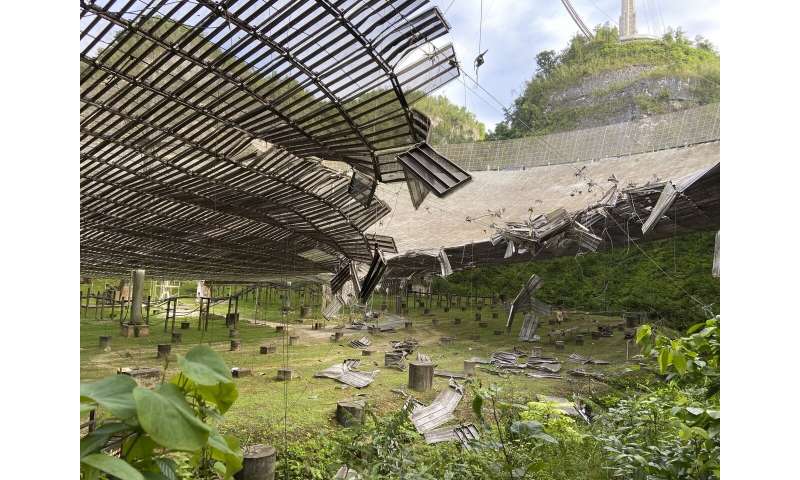
Arecibo Observatory Damaged

A broken cable caused severe damage at Puerto Rico's Arecibo Observatory, causing a suspension of operations for one of the world's largest single-dish radio telescopes.

Broken cable damages giant radio telescope in Puerto Rico 

Complete story at:

Phys.org 


Spacetime is Weird

For those of you who are interested in special and general relativity, spacetime and all that stuff, this is a really good read. Ethan Siegel, senior contributor at Forbes does a really great job of explaining some of the mysteries of our universe - indeed our very existence.

Both space and time coordinates are needed to describe an object in our Universe.

Read the article at Forbes


Record Breaking Close Encounter

A car-sized asteroid just made the closest-known approach to Earth without actually colliding with the planet. And researchers didn't even know about it until hours after it had already passed.

Asteroid 2020 QG, formerly known as ZTFoDxQ, zoomed past Earth on Sunday at 12:08 a.m. EDT, getting as close as 1,830 miles away. It marks the closest asteroid flyby ever recorded in which the object actually survived, according to NASA. (CBS News)


Monday, August 3, 2020

New Crayford focuser installed

One of the issues with the EdgeHD telescopes (actually, most SCTs) is that they are notoriously difficult to focus especially when trying to image with them. The reason is simple - focus is accomplished by moving the main mirror up and down the optical tube. Although the mirror can be locked in place once focus is achieved, as soon as the temperature changes the optical path alters a bit and the focus needs adjustment.  You can't do that remotely - you have to go out to the scope, unlock the mirror, go back inside, refocus, go back outside, lock the mirror and then continue. So I haven't been locking the mirror, just refocusing periodically throughout the night.

Another problem is that as you focus in and out the image shifts. This is because the mirror tilts a bit as it moves. And, during the night as the scope alters it's orientation to the ground, the mirror moves as well. All of this makes it hard to keep getting in-focus images during long sessions.

Well, there is a solution, and it's called the CHL 2.5 inch Large Format Crayford EDGE focuser from Moonlite.  This piece of equipment mounts on the rear of the OTA before the rest of the imaging train (OAG, Filter Wheel and Camera). Now the mirror is locked down tight and focus is achieved by moving the drawtube holding the imaging train in and out, much like a standard refractor telescope. No more mirror flop, no more shifting image, just a smooth focus operation.

I purchased one a few weeks ago, and finally got around to installing it on my scope. There were some issues getting the focus point to reach the critical 146mm. Because the Celestron Off Axis Guider I use is so wide, there wasn't a whole lot of wiggle room getting everthing connected, but it's all set up and I tested it a few days ago. And the results are outstanding. Here is a test image of a star field showing the results.


No only are the stars tack-sharp, edge to edge, but the light cone is now almost perfectly centered on the camera sensor (probably a side effect of not using any spacers so now the imaging train is really solid).  The guide camera still needs to be adjusted to support guiding, but I'll do that later this week. I might add that since I didn't have the guide system working, this test image (15x30sec) was unguided! This simply demonstrates the quality of the AP1100-GTO mount that I got back in April.

Once hurricane Isaias passes by (and the water drains) I'll complete the calibration and be ready to image once again - only now with a much better focuser in play.

Saturday, August 1, 2020

Setting up the EdgeHD-11

Cloudy skies - oh well.  While I'm waiting to get back to imaging I decided to create a short video of what my steps are in setting up for a session with the telescope.


Hope you like it.

If the video is not visible on your mobile device, get it here
 

Thursday, July 30, 2020

Comet NEOWISE fading fast

I setup for imaging NEOWISE from my home site on July 26 and the 27th.  Placed my Canon50D piggyback on the GT102 with my Canon 100mm lens. Little did I know that my focus (on both nights) wasn't set properly and so both sets of subs were very sub-par.  After trying to process them multiple times the results were just not worth the effort.  I realized later that the focus ring on my Canon lens is so loose that it can rotate out of focus really easy.  Should have taped it down or used my Tamron which is much stiffer in that respect.

With the moon reaching full phase this weekend, the skies will be awash with moonlight. Once the moon reaches a point where it doesn't rise until after NEOWISE sets the comet will have dimmed to the point where the tail is significantly reduced in size and brightness.  So it's goodbye to comet NEOWISE.  Now I'll be waiting for the next bright comet to favor our skies.

Sunday, July 26, 2020

NEOWISE from Mikey's Place

Finally, NEOWISE is high enough that I can capture it from my home with the large telescope mount.  The sky wasn't very good though, lots of thin cirrus clouds.  But I decided to image the comet anyway.

Didn't have time to process the stacked images, but here is a single sub from my Canon50D with 100mm lens piggybacked on my GT102 and AP1100 mount.

Once the subs are processed I'll post the results here.

Comet NEOWISE
July 26, 2020 - Canon 50D/ 100mm f/3.5 60 sec ISO800

Friday, July 24, 2020

Comet NEOWISE - Close Up (Update)

Well, I took another shot at getting a better image.  Processed the 22 x 30sec images taken around 9:45PM.  Since there were more subs the noise was reduced a bit and I got some of the color as well.

Comet NEOWISE - July 18, 2020 9:45 PM
GT102 APO f/5.5  -  Canon 50D  -  22x30 sec ISO800

Comet NEOWISE - Close up

On July 18, 2020, the skies were rather clear and I decided to return to my church's property with my portable telescope setup (William Optics GT-102 APO, iOptron iEQ30 mount, Canon 50D).

I wanted to get some longer exposure images of the comet with a close up on the head and so the GT102 seemed like a good bet.  I realized that I would not be getting a lot of the tail(s). 

After spending about a hour and a half, 212 images later, and lots of processing time at home, I did manage a fairly good close up of NEOWISE.  I am a little disappointed that the image showed very little color.  The green coma was visible, but the final image didn't show it.  The sky conditions were not good enough to capture the ion tail in it's full glory, but I was also disappointed in that I really couldn't pull enough detail out of it as well - also devoid of any color.  Not sure if this is due to processing issues, or sky conditions.  Anyway, here it is.

Comet NEOWISE - July 18, 2020 - ~10:08 PM
GT102 APO f/5.5  - Canon 50D - 10x60sec subs - ISO800


Once the comet gets a little higher in the sky I'll image it once again at home with both my 11" EdgeHD and a piggyback Canon with 100mm lens.  That is if the clouds go away!  Each day that goes by the comet is getting dimmer, and, there are some reports (still unverified) that the nucleus may be starting to disintegrate.  Let's hope not.

Thursday, July 16, 2020

Comet NEOWISE at night

On July 15th I arrived at CrossLife Bible Church, Westminster MD, my home church, for our normal prayer group meeting at 6:30 PM.  The service ended at 7:30 and I noticed that the skies were somewhat clearing up toward the north/northwest.  We have a clear view in the direction where NEOWISE would be and so after dropping my wife back home I returned to the church property and setup my camera.

It was 8:40 when I arrived and got setup. There was still a lot of high cirrus clouds covering the sky where NEOWISE is located. I looked for the comet from about 8:50 to about 9:41 and nothing, not with the naked eye, not with 10x50 binoculars. Then, at 9:45, I spotted it! Shinning through the thin clouds it was still a splendid sight.

Comet NEOWISE, July 15, 2020 10:06 PM
18mm, f/5.6, ISO 1600 15x5 sec


It was about 74 degrees, with a strong wind (it's always windy at the church since we sit at the top of a hill and for some reason all the air rushes right over our site). I knew I would lose some shots just due to the camera being buffeted by wind gusts over 20mph. But my patience paid off.

I took 118 images, and processed four different sets. One of those sets produced a fairly good image of NEOWISE even considering the image was shot through a layer of clouds.

Comet NEOWISE, July 15, 2020 10:08PM
270mm, f/6.3, ISO1600 10x5sec


This image of NEOWISE was taken at 10:08 PM with a Canon 70D and Tamron 18-270mm lens. The lens was set at the full 270mm focal length and aperture at f/6.3. I took 21 subs, of which I used 10 in the final stack. Each was taken with an ISO of 1600, exposure time of 5 seconds. The subs were pre-processed and stacked with Nebulosity 4.0, and the stacked image further processed in PixInsight and Paint Shop Pro. I did take darks to limit the sensor noise and hot pixels, but Nebulosity didn't do such a good job removing the pixels. You can see them in a zoomed-in version of the photo as streaks of colored dots.

Now that the weather is not looking so good for the next week or so, it looks like the next photo opportunity will be at my home with the WO-GT102 telescope on my AP1100GTO mount. The comet will likely fade a bit by then (it is moving quickly away from the sun) but it will be much higher in a darker sky, and finally high enough to clear my tree line.


Thursday, July 9, 2020

First Images of Comet NEOWISE

Early this morning I was able to capture some initial images of C/2020 F3 NEOWISE.  I had provided some charts in my previous post and with NEOWISE only getting about 10 degrees up in the NE there was no chance I could image it from my home. So I packed up my Canon 70D and headed to my church property in Westminster. I decided against bringing my portable telescope figuring I try with just the Canon on a tripod and see what I could get.

The first photo is a composite (stacked) image of 10, 2sec exposures, at a high ISO value of 3200. The Tamron 18x270 lens was set to 77mm (I had wanted 100x but somehow the zoom slipped) at f/5.6.

C/2020 F3 NEOWISE, July 9 2020, 4:54 AM
Canon 70D, 77mm, f/5.6, ISO 3200, 10x2 sec


The second is a composite of 10, 1 sec exposures at ISO 1600, 270mm, f/6.3.  Since these exposures were taken rather late, the sky had brightened considerably. Lens fogging didn't help either!

C/2020 F3 NEOWISE, July 9, 2020, 5:06 AM
Canon 70D, 270mm, f/6.3, ISO 1600, 10x1 sec


Neither set of images were processed to eliminate/minimize noise, so they are a bit noisy.

Plan is to take a few more later this week, potentially Saturday morning, weather permitting.  Then, when NEOWISE makes it to the evening skies, I'll image with the either the GT102 or the EdgeHD11.


Sunday, July 5, 2020

Comet C/2020 F3 (NEOWISE)

Well, surprise, surprise ... one of the newly discovered comets might actually be visible and is not breaking up.  With the demise of ATLAS and SWAN I was hesitant to report on any hope of sighting a comet with the naked eye anytime this year.

But, NEOWISE is still going strong and is now positioned for the northern hemisphere.

If you want to see NEOWISE you have two choices.  Early in the morning, before sunrise or (later in the month) just after sunset.  It is probably the brightest right now and will be dimming slowly over the next two weeks so catching it in the AM might be worth the early rise from bed.  For those who prefer their sleep, it will be visible in the NW after sundown, and will be rising higher and higher in the sky (important if you are viewing from a location with lots of trees - like at my observatory.)

The two charts below will give you a rough idea of where to look for the comet.  Each one is fixed at a particular time (roughly with the sun about 10 degrees below the horizon) and shows the position of the comet on each day from July 6th through the 25th.

Comet NEOWISE - Morning
Reisterstown, Maryland


NEOWISE doesn't rise very high in the early morning sky as it moves around the sun in it's orbit. It is the highest on July 10th, about 15 degrees above the horizon at 5:00 AM.  Distance between each horizontal grid line is 20 degrees.

The evening views are a little better, and the comet gets higher each succeeding night, but also dims as well.

Comet NEOWISE - Evening
Reisterstown, Maryland

Recent reports put comet NEOWISE at magnitude 1 - 2, which is certainly bright enough to be visible with the naked eye, but I would bring along a pair of binoculars if you have them.

Depending on the weather, I may be transporting my portable telescope to try to capture some images.  Later in the month, when the comet is high enough to clear my treeline, I'll capture it with my larger rig.

Graphics courtesy of Starry Night®
(Starry Night Pro) (Version 8) / Simulation
Curriculum Corp.

Supernova in NGC 7331

SN 2026aaiv is classified as a Type Ia supernova. It was discovered on September 1, 2026 in the spiral galaxy NGC 7331 in the constellation ...