Check out EarthSky for the top 10 tips for watching this shower.
Wednesday, December 13, 2017
Geminids Meteor Shower Tonight
If you had to pick one night for watching the 2017 Geminid meteor shower, it’d probably be December 13 (morning of December 14). The nights before and after should be good as well. On a dark, moonless night, the Geminids are known to produce 50-120 meteors per hour, or nearly 1-2 meteors per minute. This year, with the Geminids’ parent object – 3200 Phaethon – nearby, you might see more. Plus, the moon is in a waning crescent phase for this year’s shower; it won’t interfere, and it’ll be passing some predawn planets.

Friday, December 8, 2017
NGC 7000 - The North America Nebula
During the later part of November when we had some nice run of clear, moonless nights, I imaged a lot of DSOs (Deep Space Objects). Finally got around to processing NGC 7000.
The North America Nebula (NGC 7000 or Caldwell 20) is an emission nebula in the constellation Cygnus, close to Deneb (the tail of the swan and its brightest star). The remarkable shape of the nebula resembles that of the continent of North America, complete with a prominent Gulf of Mexico. It is sometimes incorrectly called the "North American Nebula". The North America Nebula is large, covering an area of more than four times the size of the full moon; but its surface brightness is low, so normally it cannot be seen with the unaided eye. Binoculars and telescopes with large fields of view (approximately 3°) will show it as a foggy patch of light under sufficiently dark skies. However, using a UHC filter, which filters out some unwanted wavelengths of light, it can be seen without magnification under dark skies. Its prominent shape and especially its reddish color (from the hydrogen Hα emission line) show up only in photographs of the area. The portion of the nebula resembling Mexico and Central America is known as the Cygnus Wall. This region exhibits the most concentrated star formation. (Wikipedia)
I had imaged this object with my William Optics 102mm APO, but the EdgeHD11 with Hyperstar lens really pulls out the detail. There is however, some issues with my setup of the Hyperstar. If you look closely at the top left of the image the stars are actually small donuts; at the bottom right they are pinched. I'm pretty sure this is an issue with the camera not aligning properly to the Hyperstar lens; something which I have struggled with in the past to correct.
The North America Nebula (NGC 7000 or Caldwell 20) is an emission nebula in the constellation Cygnus, close to Deneb (the tail of the swan and its brightest star). The remarkable shape of the nebula resembles that of the continent of North America, complete with a prominent Gulf of Mexico. It is sometimes incorrectly called the "North American Nebula". The North America Nebula is large, covering an area of more than four times the size of the full moon; but its surface brightness is low, so normally it cannot be seen with the unaided eye. Binoculars and telescopes with large fields of view (approximately 3°) will show it as a foggy patch of light under sufficiently dark skies. However, using a UHC filter, which filters out some unwanted wavelengths of light, it can be seen without magnification under dark skies. Its prominent shape and especially its reddish color (from the hydrogen Hα emission line) show up only in photographs of the area. The portion of the nebula resembling Mexico and Central America is known as the Cygnus Wall. This region exhibits the most concentrated star formation. (Wikipedia)
 |
| NGC 7000 - November 20, 2017 EdgeHD11 w/Hyperstar and QHY10 Camera 30x180sec subs at f/2 |
I had imaged this object with my William Optics 102mm APO, but the EdgeHD11 with Hyperstar lens really pulls out the detail. There is however, some issues with my setup of the Hyperstar. If you look closely at the top left of the image the stars are actually small donuts; at the bottom right they are pinched. I'm pretty sure this is an issue with the camera not aligning properly to the Hyperstar lens; something which I have struggled with in the past to correct.
Cars in Space - you bet!
"Payload will be my midnight cherry Tesla Roadster playing Space Oddity. Destination is Mars orbit. Will be in deep space for a billion years or so if it doesn’t blow up on ascent."

Yikes - a Roadster in orbit!
Complete story at: Elon Musk - Roadster to Mars
Tuesday, December 5, 2017
Equivalence principle passes another test
A team of researchers from the French Aerospace Lab and at the Côte d'Azur Observatory working on France's MICROSCOPE satellite project has further confirmed the equivalence principle by recreating Galileo's free-falling objects experiment in a satellite.

Read more at: PhysOrg
Saturday, December 2, 2017
Talk about Quality Engineering ...
If you tried to start a car that's been sitting in a garage for decades,
you might not expect the engine to respond. But a set of thrusters
aboard the Voyager 1 spacecraft successfully fired up Wednesday after 37
years without use.
Voyager 1, NASA's farthest and fastest spacecraft, is the only human-made object in interstellar space, the environment between the stars. The spacecraft, which has been flying for 40 years, relies on small devices called thrusters to orient itself so it can communicate with Earth. These thrusters fire in tiny pulses, or "puffs," lasting mere milliseconds, to subtly rotate the spacecraft so that its antenna points at our planet. Now, the Voyager team is able to use a set of four backup thrusters, dormant since 1980.
See the complete story at: JPL
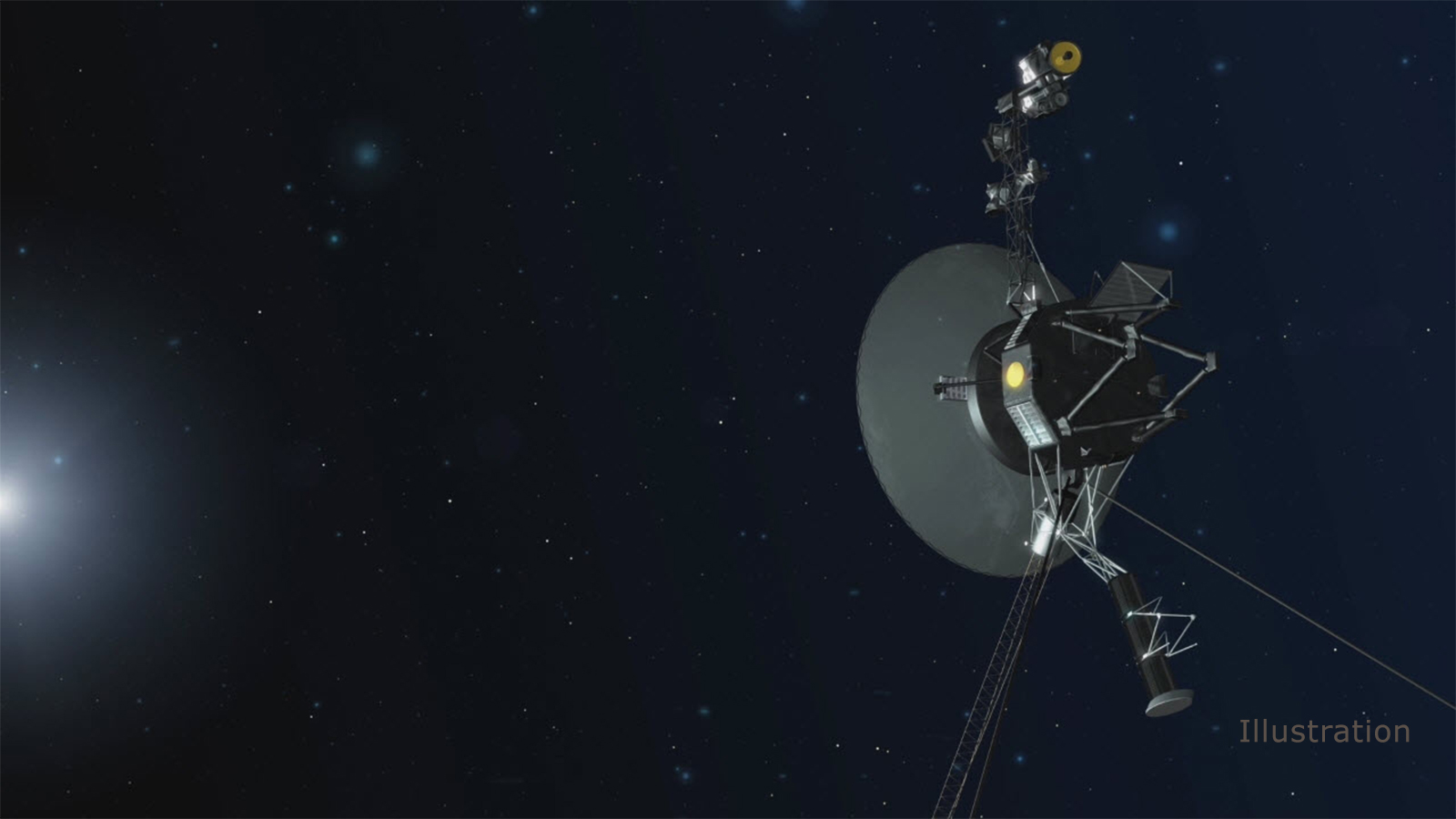 |
| An artist concept depicting one of NASA's twin Voyager spacecraft. Humanity's farthest and longest-lived spacecraft are celebrating 40 years in August and September 2017. The Voyager team is able to use a set of four backup thrusters, dormant since 1980. They are located on the back side of the spacecraft in this orientation. Credit: NASA/JPL-Caltech. |
Voyager 1, NASA's farthest and fastest spacecraft, is the only human-made object in interstellar space, the environment between the stars. The spacecraft, which has been flying for 40 years, relies on small devices called thrusters to orient itself so it can communicate with Earth. These thrusters fire in tiny pulses, or "puffs," lasting mere milliseconds, to subtly rotate the spacecraft so that its antenna points at our planet. Now, the Voyager team is able to use a set of four backup thrusters, dormant since 1980.
See the complete story at: JPL
Wednesday, November 29, 2017
The Seven Sisters (Pleiades) Star Cluster
Early Thanksgiving day morning I imaged a favorite star cluster of mine, the Pleiades or Seven Sisters. The Pleiades, also known as Messier 45), are an open star cluster containing middle-aged, hot B-type stars located in the constellation of Taurus. It is among the nearest star clusters to Earth and is the cluster most obvious to the naked eye in the night sky. The cluster is dominated by hot blue and extremely luminous stars that have formed within the last 100 million years. Dust that forms a faint reflection nebulosity around the brightest stars was thought at first to be left over from the formation of the cluster (hence the alternative name Maia Nebula after the star Maia), but is now known to be an unrelated dust cloud in the interstellar medium, through which the stars are currently passing. (Wikipedia)
This image is a processed stack of 30, 5 minute subs, taken with my WOGT102mm APO refractor and QHY10 camera.
 | |
| M45 (The Pleiades) - Nov 23, 2017 WO-GT102 and QHY10 Camera 30x300sec Subs at -20C - f5.5 |
This image is a processed stack of 30, 5 minute subs, taken with my WOGT102mm APO refractor and QHY10 camera.
Saturday, November 25, 2017
New Images
I just noticed that a good portion of my past images have not had the correct dark frames processed on them. This means that thermal noise from my camera was not getting subtracted out. Granted the QHY10 operating at -20C doesn't produce a lot of thermal noise, there is still some there and it should be removed.
Adjusting for the new parameters in PixInsight I re-ran the M33 image taken with my WO GT102 APO. The image is a little darker, but the noise is greatly reduced. I may decide to reprocess some of my past images to allow for this improvement.
On November 24, 2017, I placed my main telescope on automatic and scripted it to take ~3.5 hours of NGC 891, an edge on spiral galaxy while I got some needed sleep :). Results were really good. 44 subs, each 300 seconds long were taken in the wee hours of the morning. Here is the end result of that session.
NGC 891 (also known as Caldwell 23) is an edge-on unbarred spiral galaxy about 30 million light-years away in the constellation Andromeda. It was discovered by William Herschel on October 6, 1784. The galaxy is a member of the NGC 1023 group of galaxies in the Local Supercluster. It has an H II nucleus.
Adjusting for the new parameters in PixInsight I re-ran the M33 image taken with my WO GT102 APO. The image is a little darker, but the noise is greatly reduced. I may decide to reprocess some of my past images to allow for this improvement.
 |
| Updated M33 with Dark Frame Subtraction |
 |
| NGC 891, Nov 24, 2017 EdgeHD11 at f7.0 - 44x300sec subs with QHY10 |
Friday, November 24, 2017
Back in business
A few nights ago my main telescope mount started to act erratically. It would swing uncontrollably in the RA axis and resetting power didn't help. Thinking the worst - a bad motor control board or motor, I removed the RA motor and tested it out. Sure enough, when the RA motor was connected to the DEC axis the problem occurred. The issue is definitely correlated to the motor.
I contacted Ed at DeepSpaceProducts for the availability of a new motor. after describing the issue to him he suggested I first open the motor's encoder casing and check to see if the encoder assembly is OK since it sounded like an encoder problem to him. I found that the encoder disk was loose. Once tightened the issue was resolved. That saved me about $180. And, as usual, Ed is more interested in getting his customers back in business than he is just selling product.
Testing on real imaging last night reveals that the RA motor is fixed.
Not to waste a clear night, I set up the William Optics 102mm APO to capture some galaxies. Here is M33, the Triangulum Galaxy, also known as the Pinwheel Galaxy.
The Triangulum Galaxy is a spiral galaxy approximately 3 million light-years (ly) from Earth in the constellation Triangulum. It is catalogued as Messier 33 or NGC 598. The Triangulum Galaxy is the third-largest member of the Local Group of galaxies, behind the Milky Way and the Andromeda Galaxy. It is one of the most distant permanent objects that can be viewed with the naked eye.
I contacted Ed at DeepSpaceProducts for the availability of a new motor. after describing the issue to him he suggested I first open the motor's encoder casing and check to see if the encoder assembly is OK since it sounded like an encoder problem to him. I found that the encoder disk was loose. Once tightened the issue was resolved. That saved me about $180. And, as usual, Ed is more interested in getting his customers back in business than he is just selling product.
Testing on real imaging last night reveals that the RA motor is fixed.
Not to waste a clear night, I set up the William Optics 102mm APO to capture some galaxies. Here is M33, the Triangulum Galaxy, also known as the Pinwheel Galaxy.
The Triangulum Galaxy is a spiral galaxy approximately 3 million light-years (ly) from Earth in the constellation Triangulum. It is catalogued as Messier 33 or NGC 598. The Triangulum Galaxy is the third-largest member of the Local Group of galaxies, behind the Milky Way and the Andromeda Galaxy. It is one of the most distant permanent objects that can be viewed with the naked eye.
 |
| M33 - Nov 22, 2017 WO GT102 - F/5.5 29x300sec QHY10 Camera |
Sunday, October 29, 2017
M77 - A galaxy in the constellation of Cetus
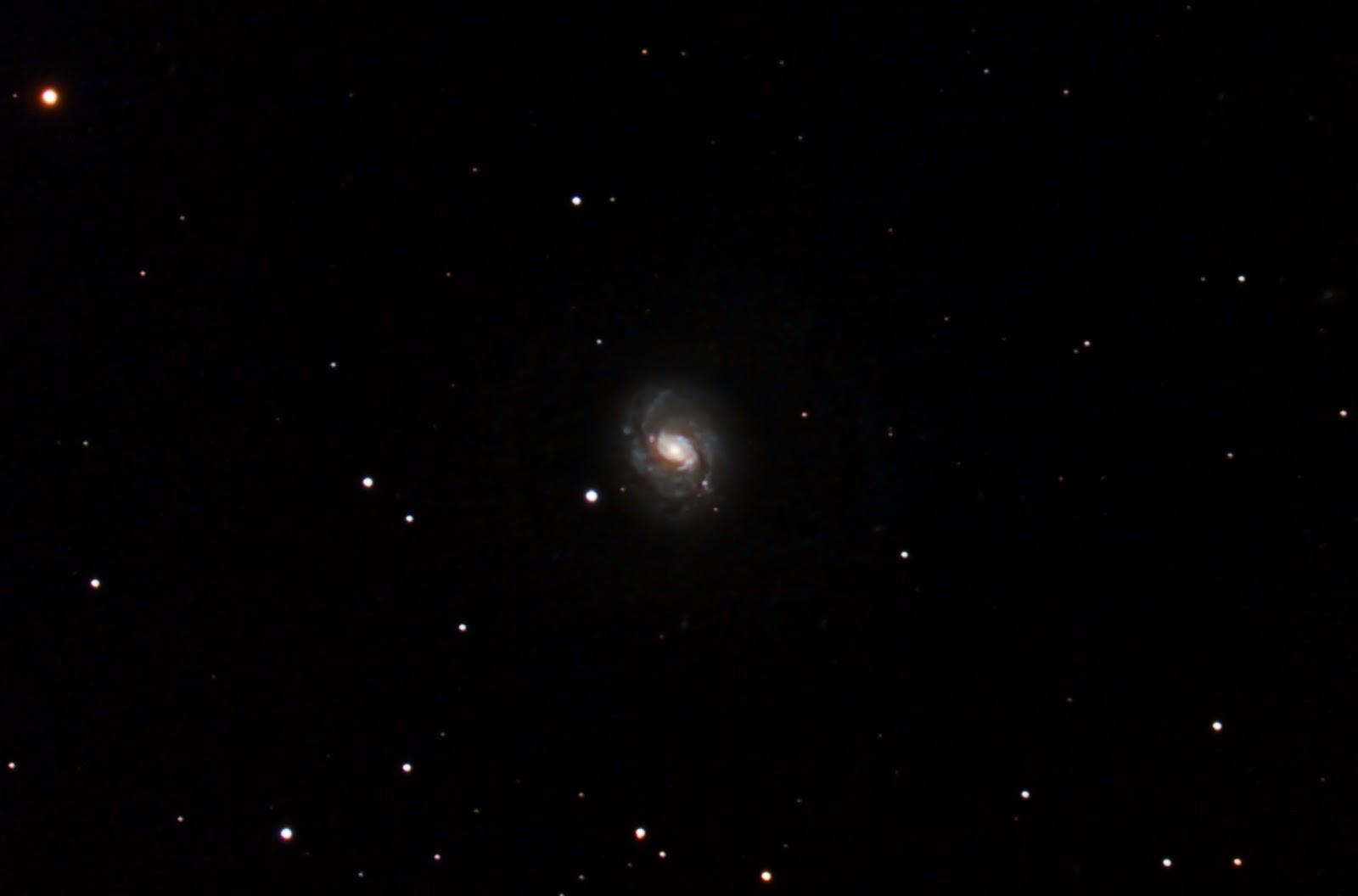 |
| M77, October 20, 2017 EdgeHD-11, f/7 39x180sec at -20C QHY10 Camera |
Wikipedia
Saturday, October 28, 2017
New Images - The Crab and Dumbell Nebulae
With the string of nice clear nights recently, I finally got a chance to spent a good amount of time repairing both my mounts and then imaging some popular DSOs (Deep Space Objects).
First, the iOptron replacement mount was delivered last Friday from the manufacturer and the new mount (they finally agreed to replace the mount rather than try to fix it for the third time) now operates flawlessly. I was actually able to take a few 3 minute subs without autoguiding! Still need to do a few more tests, but it does look encouraging.
Now the main mount (CGEM) has been giving me trouble for the past 10 months, and I finally got around to readjusting the gear meshing. Then I reloaded the software that controls the mount. Alas, I finally got the mount to operate within specs once again. It seems like the combination of some mechanical adjustment and resetting the software parameters got it back to working order.
With the CGEM now able to track well enough for imaging at near prime focus, I was off to photographing a bunch of objects while the skies remained clear and the moon out of the picture.
So here are the first two objects of the five I imaged that I have processed.
M1, the Crab Nebula, is a supernova remnant in the constellation of Taurus. Recorded by Chinese astronomers in 1054, the nebula was observed later by English astronomer John Bevis in 1731. The nebula was the first astronomical object identified with a historical supernova explosion. At an apparent magnitude of 8.4, comparable to that of Saturn's moon Titan, it is not visible to the naked eye but can be made out using binoculars under favourable conditions. The nebula lies in the Perseus Arm of the Milky Way galaxy, at a distance of about 2.0 kiloparsecs (6,500 ly) from Earth. It has a diameter of 3.4 parsecs (11 ly), corresponding to an apparent diameter of some 7 arcminutes, and is expanding at a rate of about 1,500 kilometres per second (930 mi/s), or 0.5% of the speed of light.
M27, the Dumbell Nebula, is a planetary nebula in the constellation Vulpecula, at a distance of about 1,360 light-years. This object was the first planetary nebula to be discovered; by Charles Messier in 1764. At its brightness of visual magnitude 7.5 and its diameter of about 8 arcminutes, it is easily visible in binoculars, and a popular observing target in amateur telescopes.
First, the iOptron replacement mount was delivered last Friday from the manufacturer and the new mount (they finally agreed to replace the mount rather than try to fix it for the third time) now operates flawlessly. I was actually able to take a few 3 minute subs without autoguiding! Still need to do a few more tests, but it does look encouraging.
Now the main mount (CGEM) has been giving me trouble for the past 10 months, and I finally got around to readjusting the gear meshing. Then I reloaded the software that controls the mount. Alas, I finally got the mount to operate within specs once again. It seems like the combination of some mechanical adjustment and resetting the software parameters got it back to working order.
With the CGEM now able to track well enough for imaging at near prime focus, I was off to photographing a bunch of objects while the skies remained clear and the moon out of the picture.
So here are the first two objects of the five I imaged that I have processed.
 |
| M1 - October 21, 2017 - EdgeHD-11 40x180sec, f/7, -20C QHY10 Camera |
 |
| M27 - October 19, 2017 - EdgeHD-11 26x180sec, f/7, -20C QHY10 camera |
Saturday, October 14, 2017
Can It Be?
I've been watching the local weather forecast and the 'Clear Outside' forecast for a couple of days, and ... is it possible ... clear, cool, transparent skies, without the moon, for 5 days??!! Yikes. Got to plan my imaging runs :)


Subscribe to:
Posts (Atom)
Supernova in NGC 7331
SN 2026aaiv is classified as a Type Ia supernova. It was discovered on September 1, 2026 in the spiral galaxy NGC 7331 in the constellation ...

-
Like in any tech field, advancements in technology, tools, and processes keep pushing the boundaries of what’s possible, and astrophotograph...
-
 Today, March 23, 2026, marks the official beginning of the construction of NightSky Observatory at the Mangieri residence. OK, earlier this...
