Thursday, April 27, 2017

Postal Service new Eclipse Stamp

Now here is a novel idea for a commemorative stamp.  The Postal Service will soon release a first-of-its-kind stamp that changes when you touch it. The Total Solar Eclipse Forever stamp, which commemorates the August 21 eclipse, transforms into an image of the Moon from the heat of a finger.  The public is asked to share the news on social media using the hashtag #EclipseStamps.

Complete story at:  USPS News

Wednesday, April 19, 2017

Negative Mass - the world of Quantum Physics gets stranger!

Artist's abstraction (stock image) - Credit: © ktsdesign / Fotolia
Washington State University physicists have created a fluid with negative mass, which is exactly what it sounds like. Push it, and unlike every physical object in the world we know, it doesn't accelerate in the direction it was pushed. It accelerates backwards.

See story at ScienceDaily

Sunday, April 16, 2017

LDRS 36 at Higgs Farm

When I heard that LDRS was coming to MDRA this year I had to come out of my 3 and a half year hiatus in rocketry (having two expensive hobbies can take a toll on your finances).  Although I had planned to attend on Thursday and Friday the weather was terrible and so I modified my plans and took the trip to Price, MD on Friday and Saturday.

Friday wasn't all that much better than Thursday as it turned out.  The winds were up to 20-30MPH and it was cold. I stayed most of the day, but didn't launch anything. I did, however, help a friend get his Level 1 certification, so the day wasn't a total wash.

Saturday was much better. Winds were still a bit on the breezy side but manageable. And the temperature was warmer.

I decided not to prep and fly the largest rocket in my fleet, the Talon-2, as planned, since I didn't like the winds and I was still feeling the effects of my cold that I was trying to shake for the last two weeks. But both the Emerald Fire and Mustang-XL were ready to go.

The Emerald Fire was first up. Loaded with a K805G motor (propellant is a green formulation appropriate for a rocket named Emerald Fire) and a Ozark GPS telemetry head in the nosecone, she raced off the pad for a really nice flight to 3,700 feet. She reached a maximum velocity of 322 ft/sec.

Plan was to capture some GPS telemetry data for plotting on Google Earth, but since I forgot to set the data recorder I got nothing. I guess when you're away from rocketry for over 3 1/2 years you tend to forget a few things - now where was that checkist :)

The Mustang-XL was a pure sport flight and it performed very well. Loaded with a J450 DM motor, the takeoff was loud, sparky and cool to watch. She quickly climbed to 4,700 feet with a maximum velocity of 670 ft/sec before landing off to the right about 2000 feet across Ell Downes road. The rocket was carrying a Trackimo device which sends GPS signals via the cellular network.

Video my two flights is up on YouTube:  Video

LDRS was a huge success, and I enjoyed my time back on the rocket field. According to MDRA there were a total of 713 rocket launches during the 4-day event.

Saturday, March 18, 2017

Comet Johnson

Just got done with the processing of some subs I took of comet C/2015 V2 Johnson on March 3rd.  The fact that the comet was so close to the bright star Tau Herculis (mag 3.9) made it really difficult to get the image processed.  It's not great, but it is in there; green and all! 
C/2015 V2 (Johnson)
March 3, 2017
EdgeHD11 Telescope at f/7   40x180sec subs

Why green?  Many comets have an abundance of chemical compounds such as cyanide (CN2) and carbon (C2). When these compounds are ionized, due to the sun's energy, they emit light in the green spectrum.  Hydrogen (more common) also glows but is much fainter. 

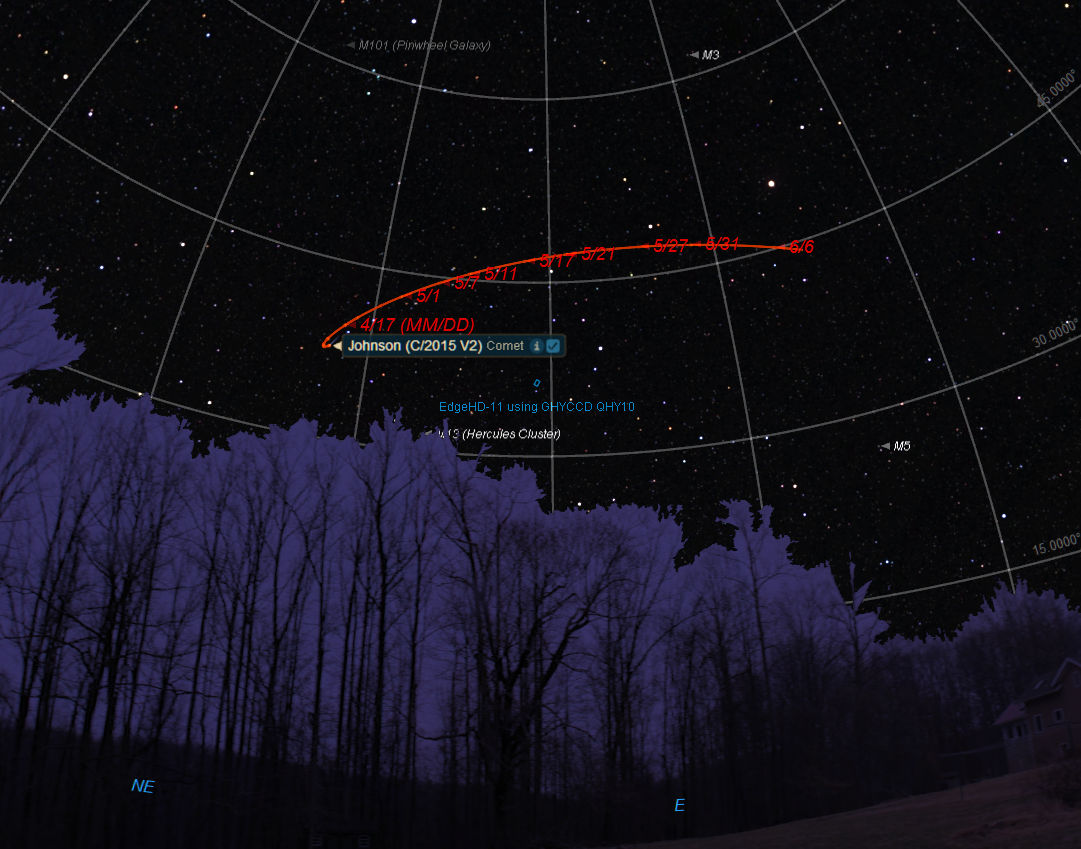
Johnson's orbit really favors us northerners as she will be high in the NE - E over the entire time.  The chart shows Johnson on March 18, 2017 at midnight, with the future positions marked in red.  Note however, that every day the comet actually gets higher and higher due to the earth's rotation and the fact that the comet is following a rather straight path to the west.  It is about 37 degrees up from the eastern horizon right now, but by May 15th she'll be directly overhead at midnight.  So by then you could see the comet the same as now in March but at 9:00PM rather than midnight.

C/2015 V2 (Johnson) is a hyperbolic comet discovered on 3 November 2015 by Jess Johnson (Catalina Sky Survey) at an apparent magnitude of 17.1 using a 0.68-meter (27 in) Schmidt–Cassegrain telescope (Wikipedia).  Since the orbit is hyperbolic, Johnson will not return to our solar system, but after passage later this summer she will head out to deep space.

I'll be imaging Johnson whenever I can.  By June she may even be visible to the naked eye in dark skies.  Certainly visible with binoculars.

Wednesday, March 15, 2017

Comet 41P/T-G-K now easily visible in binoculars

Starting this week, and for the next 15-30 days or so, comet 41P should put on a good show.  In early April it may even reach naked-eye visibility (for those of us far away from any light pollution that is).  For the rest of us binoculars will do the trick.
Hisayoshi Kato

As an avid comet chaser I'm always ready to image new (and old) comets with my Edge11 and now with my new WO102. Of course, the latest snowstorm and subsequent cloudy and windy nights is making this a bit difficult. But there is still time, and as soon as the skies clear I'm out there.

Complete info on viewing 41P can be found at Sky and Telescope

Saturday, February 25, 2017

Super-Earth is no place for a human

With all the news lately about newly discovered Super-Earths, its almost natural to assume that one of these planets may support life - and maybe we'll discover that in our lifetimes.  The problem is, of course, that the term Super-Earth is misleading at best.


I've always been wary of any news report claiming a likely 'earth like planet' has been discovered. Not that I want to quash any hopes of finding life out there in the universe, but the so called 'Super Earths' won't be the ones that probably have it.

The Forbes article here, by Ethan Siegel, explains why in just enough detail for almost anyone to understand.  I'm still hopeful that we will find a life supporting planet, but it may be awhile.

Friday, February 24, 2017

Seven Earth-Sized Planets Orbit Dim Star

Astronomers have found seven Earth-sized planets around a cool red dwarf, all of which have the potential for liquid surface water.


Article by Camille M. Carlisle | February 22, 2017 (Sky and Telescope) details the top news of the week.

Thursday, February 2, 2017

New results from CERN - Fix to the Standard Model of physics?

Proton-proton collision in the LHCb. Credit: CERN
Of the many unanswered questions that stand in the way of the Standard Model of physics being able to adequately explain the Universe and everything in it, the mystery of matter-antimatter asymmetry is one of the biggest.

The equal amounts of matter and antimatter produced by the Big Bang should have cancelled each other out, resulting in a Universe with barely any particles, and yet, here we are. Now, new results from a Large Hadron Collider detector at CERN could be our best chance at explaining the paradox of our own existence.

For the complete story see:  Science Alert

Monday, January 30, 2017

Incredible images of Saturn's Rings from Cassini

As the Cassini spacecraft continues it's death spiral into Saturn it is returning some fantastic new views of that planet's ring system.
NASA/JPL-Caltech/Space Science Institute

Head on over to Universe Today for some stunning images and descriptive story.

Friday, January 27, 2017

Get Your Iridium Fix Before It’s Too Late!

Ever seen an Iridium flare?  Don't know what they are?  Iridium flares are the sudden increase in intensity of sunlight bouncing off the highly reflective surfaces of the Iridium communications satellites, and they are awesome to see.  But, the window of opportunity to see them is closing as the replacement Iridiums are already being sent up (SpaceX’s Falcon 9 delivered the first 10 of a new generation of Iridium NEXT satellites to low-Earth orbit back on January 14th)  and these will not produce the famous flares.

Complete story and guide to how to locate and view the flares can be found at Sky And Telescope.

Thursday, January 26, 2017

Metallic Hydrogen? Really!!

Silvera et al., Science
We all learned in school that hydrogen, the simplest of all elements (one proton, one electron), is a gas - lighter than air, and abundant in the universe.  In fact the early universe was only hydrogen, but that's another story.  But years ago scientists speculated and theorized that under the proper conditions (very cold temperatures and high pressure) hydrogen could become a metal - yes, a metal.

Well, more than 80 years after it was first predicted, physicists have actually created metallic hydrogen - a mysterious form of hydrogen that could be capable of superconducting electricity without resistance at room temperature.  Really amazing stuff considering that this is something that has never existed before!

Read the complete story over at Science Alert.

Supernova in NGC 7331

SN 2026aaiv is classified as a Type Ia supernova. It was discovered on September 1, 2026 in the spiral galaxy NGC 7331 in the constellation ...