Sunday, October 27, 2013

Finding ISON

So I spent Saturday working on the repair of the power jack and decided to go with the 'non-elegant' solution. The fix was to run a set of wires from the inside of the mount through the hole where the existing jack was located and to a new inline jack. The power is then plugged into the external jack (see pic). Works like a champ.


With the new telescope up and running I tried to locate comet ISON on Saturday. No luck. Not sure if it was the bright sky (due to the moon) or the low elevation of the comet, but try as I might I couldn't verify that I picked up ISON.

No matter, as soon as the moon gets out of the way (in a few days) I'll try again.

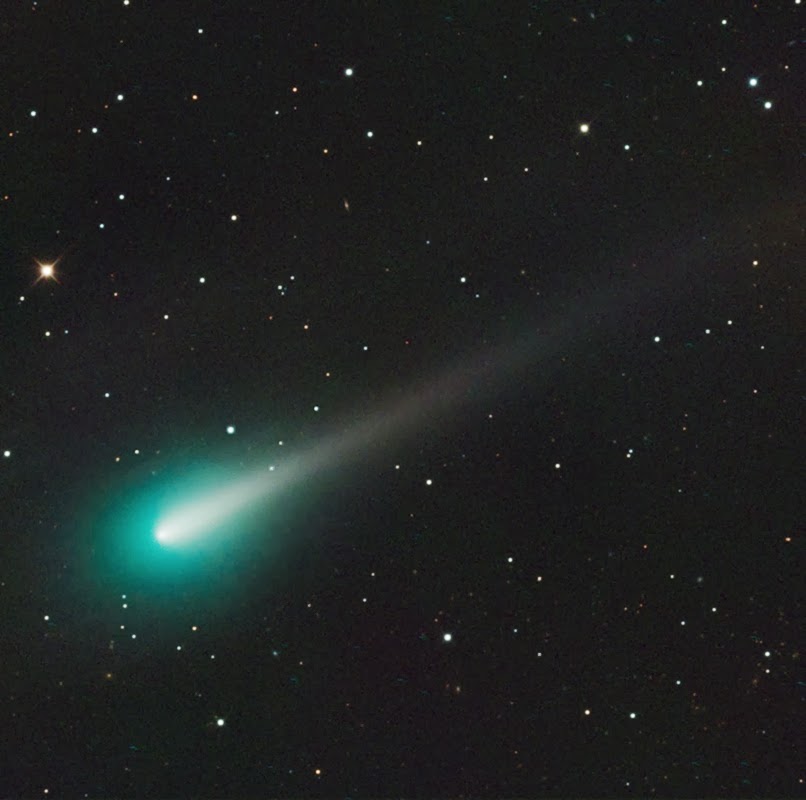
Adam Block/Mount Lemmon SkyCenter/University of Arizona (October 8, 2013)

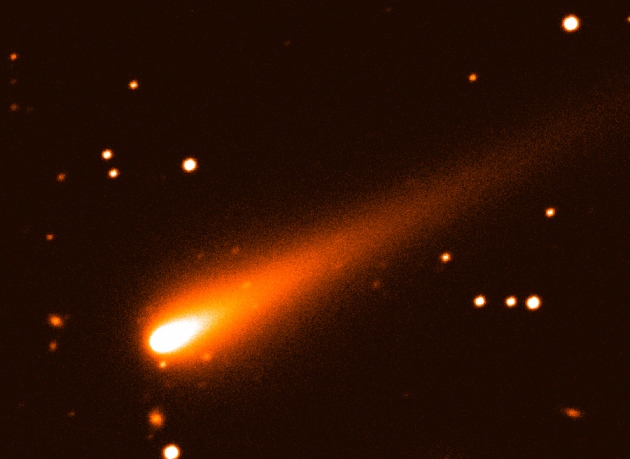
ISON will lie closest to the Sun November 28 — at just 680,000 miles from its surface. Wow, that's close, hence why we call comets like ISON sungrazers. Latest predictions indicate that it will peak at magnitude –4.5, equivalent to the brightness of Venus.

On December 8, Comet ISON crosses into the northern sky. It should shine brighter than 1st magnitude and perhaps sport a spectacular tail. Northern Hemisphere viewers will get increasingly better views as Christmas approaches.

Saturday, October 26, 2013

New Telescope Arrives

Well, I decided to purchase a new telescope before Christmas so that I would have it for observing comet ISON. I took vacation time to stay home to wait for the arrival (the five boxes came at 2:00PM on Friday). Since I bought it from OptCorp in California, and was ordered Monday afternoon, getting here by Friday was great. And OptCorp paid the UPS charges (at 200lbs that was great too!)


Spent most of the afternoon setting up the mount and stuff. Of course, Lucy (the dog) insisted I play 'stick' with her the whole time, the process took much longer than normal. Turn a screw; throw the stick. Adjust a cable; throw the stick. Attach the counterweight, throw the stick. Well, you get it.

By early evening I was up and running. Spent a couple of hours learning how to align the scope and use the various features. All was going well; I was ready to view ISON early on Saturday morning after viewing some the other interesting objects to test out the optics. I was also going to spend some time making sure I could piggyback my camera on the scope in anticipation of photographing ISON later this month.

Then it happened - only 6 hours old - I accidently yanked the power cord from the mount. And, since it was screwed it in to keep it from popping out unexpectedly, the angled force snapped the power jack right off. Argh!!

Well, it looks like I can get a new jack from RadioShack and solder it in. Voids the warranty on the mount, but the thought of sending the mount back for repairs is the last option I want to take - the freight would be expensive and then the down time would be prohibitive. I've repaired and built electronic gear before so I am confident I can make the repairs myself. So, looks like I know what I'm going to be doing on Saturday. Luckily, the power plug can still be seated in what remains of the jack as long as I tape the cord to hold it. It lasted so far as I've been able to use the scope this past evening (and as I write this it's still working). But a real permanent fix is absolutely needed. I may even forgo the jack and wire an external jack. Wont look as neat, but would prevent this from happening again.

Initial impressions: this telescope is fantastic. Well built, the optics are outstanding. Money well spent!  ISON, I'll be ready for you.

Tuesday, October 15, 2013

ISON not yet visible in binoculars

After getting up and going outside at 5:00 AM this morning to find comet ISON with my 10x50 binoculars it suddenly dawned on me that binoculars would not pick up a 9th or 10th magnitude object. Sure enough, no ISON ... but the stars were wonderful. I spent 20 minutes or so viewing the Pleiades, M42 (the Great Nebula in Orion) and Jupiter's moons - yep, the sky was so crystal clear that I could easily make out Jupiter's moons with hand-held 10x50s.

I was going to bring out the 8" telescope tomorrow morning but now it seems the weather is not cooperating! So, looks like I wait until later towards the weekend.

So, when will ISON be visible in binoculars? Probably by the end of the month when the comet should reach 6th or 7th magnitude.

Monday, October 14, 2013

All planets orbit stars ... right?

Well, maybe not.  Michael Liu (Institute for Astronomy, University of Hawaii) has released images of a young planet that's drifting through space on its own. Check out the story on SkyandTelescope.com.

Wednesday, October 9, 2013

Upcoming MDRA Launch

MDRA will hold ESL 185, at The Central Sod Farm, (Centerville, Maryland). The launch will be 10-12-13 and 10-13-13. The Sod Farm works until noon on Saturday, so plan your arrival no earlier than 11:00 A.M. The Sunday launch will start around 9:00 A.M. 
There is still no date for Red Glare. As soon as one is announced I will post here.

Good news for comet watchers

Looks like there is some good news concerning comet ISON as reported in Nature.com. There is a good chance that ISON will survive the close approach with the Sun. And if it does, ISON will likely become visible to the naked eye in December.

Saturday, September 28, 2013

Comet ISON is here ... sort of!

Well it's been over a year since comet ISON (C/2012 S1) was first discovered by Vitali Nevski and Artyom Novichonok of Russia on 21 September 2012. Now, just about to pass Mars’ orbit on the way to the Sun, C/2012 S1 will come to perihelion (closest approach to the Sun) on 28 November 2013 at a distance of 0.012 AU (1,800,000 km; 1,100,000 mi) from the center point of the Sun. That’s pretty darn close! If it survives its close encounter we may be in for a real treat come early December when ISON may become one of the greatest comets of all time.

Predicting comet brightness is difficult at best. There have been many flops in the last few decades (some will remember – or not – comet Kohoutek in 1973-74 which was then called the “Comet of the Century”). However, even though recent data suggests ISON will not be as bright as originally predicted it should still be visible to the naked eye and sport an easily identifiable tail.

Although not visible to the naked eye in October, those with binoculars or small telescopes should be able to pick up ISON as it heads closer and closer to the Sun. A good time to look is early in the morning on October 15 when ISON passes just 1° north of Mars in the constellation of Leo the Lion. It makes the leftmost point of a line created by Mars and Regulus, about 1° between each. The comet will be dim, about magnitude 9, but patient observers should be able pick her out. It's unlikely that you will be able to see any tail, but a fuzzy spot should be apparent.
ISON in the east, October 15, 2013 5:00 AM
About 22° above the horizon

As seen in a typical pair of 10x50 binoculars
As ISON approaches I will be planning to view it and will report any news here. Will ISON be the Comet of 'this' Century? We can only hope.

Friday, September 27, 2013

Last Centreville Launch of the Season

MDRA will host the last launch at the Central Sod Farm (Centreville, MD) on the weekend of Oct 12 and 13th, 2013. I will probably not be there - still working on other things.  Saturday's launch activities start around noon; Sunday goes from 9:00 to about 4:00 or so.

Starting in November we move to Higg's Dairy Farm in Price. Red Glare 15 dates have not been announced yet. Stay tuned!

Details on October's launch and other rocket info can be found on the MDRA site.

Monday, September 16, 2013

More Flares

Later on Saturday, Iridium 45 flared nicely. The moon was very near but the flare was still extremely easy to see. Here is a photo and video of the event.
 

Saturday, September 14, 2013

Flare

Got up early this morning to capture a bright Iridium Flare. Had some issues with the camera but got this shot.
Iridium 80
September 14, 2013  5:18 AM   

Thursday, September 12, 2013

Rocket Launch this weekend

MDRA will hold ESL 184, at The Central Sod Farm, (Centerville, Maryland). The launch will be 9-14-13 and 9-15-13. I will not be there as I haven't completed my latest projects and still have a lot of work to do about the estate. 

Go to MDRA for information on the launch.

Supernova in NGC 7331

SN 2026aaiv is classified as a Type Ia supernova. It was discovered on September 1, 2026 in the spiral galaxy NGC 7331 in the constellation ...